What is Politics?
The scope of politics in the wealth of commodities, which Adam Smith called the "Wealth of Nations", and Karl Marx alludes to in "the immense collection of commodities."
Modern politics arises from the coup of Reason (Rationality of Modernity) over Causes (Aristotle and Marx).
Aristotle and Marx postulated causes of objective features of reality that are independent (not separated) of mind and language, i.e., natural being and entities.
René Descartes and John Locke postulated rationality i.e., the power of the human mind.
Politics arises from the divergence between causes and reason
Author
khalid Faris
From where does politics arise in human modern history? To answer the question, we should ask what politics is. I will address this question by discussing four themes: 1) Introducing Aristotle's four causes (Material, Formal, Efficient, Final), which, according to Aristotle, are objective features of the world, independent of the human mind or language; in other words, they are naturally in things being or entities. 2) Mapping Marx’s concept of wealth of society to Aristotle's four causes, as Marx is an Aristotelian in that he preserved the objective feature of reality, but also reveals to us where Aristotle missed in his understanding, when he said ‘there can be no exchange without equality, and no equality without commensurability.’, 3) The shift from Aristotle’s concept of causes to the modern concept of reason. 4) The impact of this shift in (3) on politics. The discussion should reveal how modernity's politics took the side of reason in a manner that divests the four causes of Aristotle. In turn, reason is not independent from the human mind; therefore, the objective features of the world are understood through rationality, not causes as such. Accordingly, reason and politics are coined to stamp on the central role of the nation-state and market as organizing forces that originate from contingent conditions, not objective features of reality, that is to say, deviating from the necessary natural aspects of humanity as conceived by Aristotle and Marx. We will also scrutinize Marx's critique of political economy and present Marx’s argument about the compromise by reason on formal and final causes in Aristotle's four causes.
Aristotle's Four Causes:
1) Material cause is what persists during different transformations, that out of which a thing comes to be. 2) Formal cause: Attribute a specific structure or arrangement to the material contents. What is vital for the formal cause is to grasp and represent the essence of an entity because it’s a real entity as an objective entity in nature, i.e., bear those features in reality. 3) Efficient cause: The efficient cause is the proximate originator of change and rest, the agent that imposes the shape or structure. ‘The primary source of the change or rest,’ this is the maker of things like labor, politicians, or agents. 4) Final goal: Which is that for the sake of which something happens, has a dual meaning: it can be either a goal, or the order by which something happens.
Mapping Marx’s concept of wealth of society and commodity to Aristotle's four causes:
The way Marx understands the structure of the capitalist mode of production reveals that politics should arise from the dialectics of wealth. So what is the dialectic of wealth, or what is the dialectic of the politics of wealth?
I should resort to the four causes to unleash the constituent of the wealth to pave the way for the next section to discuss the trajectory of modern rationality on wealth, which will be followed by a section about the root cause of politics and the politics of wealth. The historical link between wealth and commodity is captured by Marx in Capital I: “The wealth of societies in which the capitalist mode of production prevails appears as an ‘immense collection of commodities’; the individual commodity appears as its elementary form. Our investigation, therefore, begins with the analysis of the commodity.”
Our task, then, is to address the scope of commodities that correspond to the four causes, or to map the four causes to the commodities.
1) Commodity as a material cause: this should be the matter as a material content that is the constituent elements plus the “Socially necessary labor-time is the labor-time required to produce any use-value under the conditions of production normal for a given society and with the average degree of skill and intensity of labor prevalent in that society.” “2) Commodity Formal cause: the way in which it is structured, or its constituent elements are arranged and organized, that will constitute its essence. This is the natural form of the product, the shape that gives the product its usefulness. This is A) The form of use-value: “Commodities come into the world in the form of use-values or material goods, such as iron, linen, corn, etc. This is their plain, homely, natural form.” B) the concrete form of labor: “With the disappearance of the useful character of the products of labor, the useful character of the kinds of labor embodied in them also disappears; this in turn entails the disappearance of the different concrete forms of labor. They can no longer be distinguished, but are all together reduced to the same kind of labor, human labor in the abstract,” C) the particular form “all labor is an expenditure of human labor-power in a particular form and with a definite aim, and it is in this quality of being concrete useful labor that it produces use-values.” 3) Efficient cause: this is going to be the work itself i.e. labor power, the qualitative formation by the power of labor and the process of objectification., A) “eternal natural necessity which mediates the metabolism between man and nature, and therefore human life itself,” “the forms of labour through which their existence is mediated – tailoring and weaving.” B) ‘For in the first place, however, varied the useful kinds of labor, or productive activities, it is a physiological fact that they are functions of the human organism and that each such function, whatever may be its nature or its form, is essentially the expenditure of human brain, nerves, muscles and sense organs.’ so labor is the maker of things that render them aware of their causes. 4) final cause: Use-value is part of a collective or social objectification, which is a genuine human activity to preserve nature and humanity, a social process of giving a form or structure to a passive object in nature. At the same time, humans give themselves social existence by coming together through the objectification of a world of their creation and reflection. It’s not individuals acting independently and discreetly from each other. In Marx’s notion of freedom, social objectification is to be a social power; freedom is the development of the ability and the tri-mutual development of nature, society, and individuals.
We conclude that Marx, as a materialist, believed in Aristotle's four causes because they are grounded in an objective reality of entities independent of the human mind and language; in other words, they are natural entities that are aligned with natural processes.
The shift from Aristotle’s concept of causes to the modern concept of reason:
Aristotle’s four causes have explanatory power to the objective feature of reality; however, Enlightenment thinkers and philosophers like René Descartes and John Locke adopted a different strategy where understanding should be dependent on the mind, the so-called reason or rationality. To that end, they rejected the formal and final causes and postulated the efficient and material causes in terms of reason rather than cause. So, reason in modernity arises from stripping away the formal and final causes attributed to natural entities, as Aristotle argued and as Marx stated explicitly in Das Kapital.
Now we need to look at how Marx characterizes the becoming of the capitalist mode of production, in which the formal and final causes are compromised. First, we have to highlight that Marx, in Capital I, pointed out that Aristotle failed to discover the equivalence relations because of the historical limitations inherent in Greek society, which was founded on slave labor. Hence, inequality had as its natural basis. Therefore, Marx’s understanding of value in the capitalist mode of production is crucial for revealing how the formal and final causes are compromised.
According to Marx, the formal cause of what society produces compromised by “Accidental Form of Value x commodity A = y commodity B or: x commodity A is worth y commodity B. (20 yards of linen = 1 coat, or: 20 yards of linen are worth 1 coat)”, “commodities have a common value-form which contrasts in the most striking manner with the motley natural forms of their use-value”, this is the bourgeois method of structuring the “immense collection of commodities,” in other words the structure of capital accumulation.
As formal cause preserves the essence of natural form and the efficient cause preserves the natural necessity of work, both must be compromised to make room for rationality in the modern sense, thereby opening the door to the theatre of politics of rationality, not of objective causes. We can now read Marx’s Aristotelian four causes through the lens of Enlightenment-era rationality.
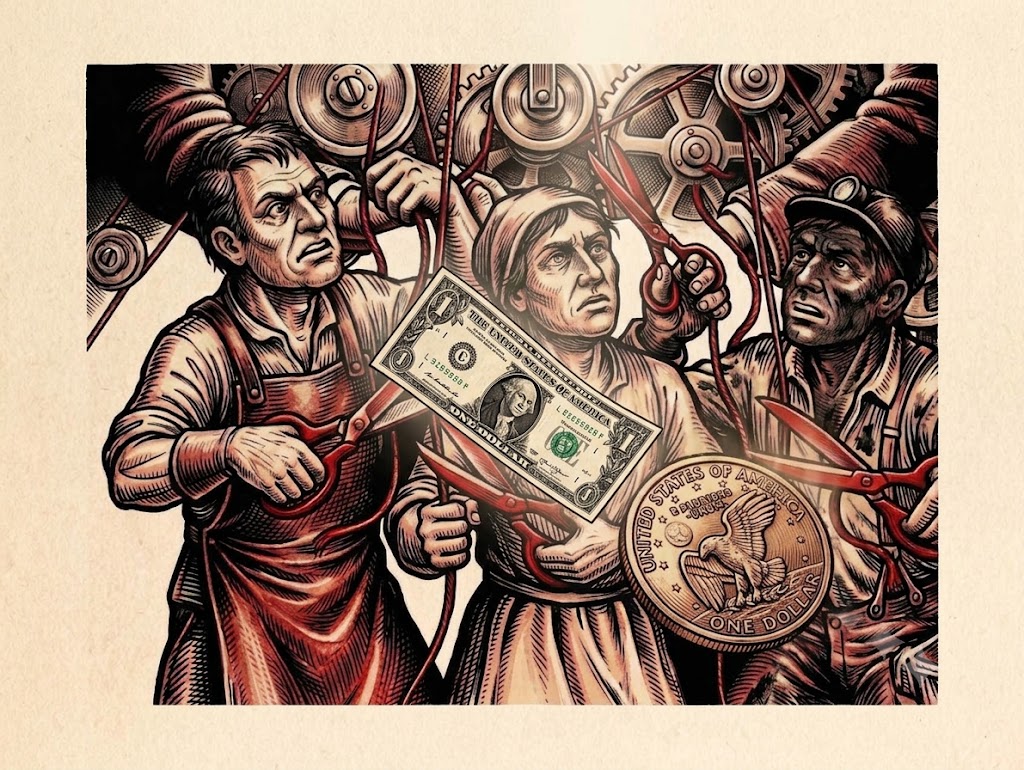
The exclusive mutuality between politics and wealth renders the commodity the center of gravity of politics, where the commodity’s final goals are the de facto. Meaning that the question of society's existence is tied to its ability to accumulate wealth. So, politics aims to ensure that society produces the level of wealth that sustains its existence and development. Therefore, to think of politics in terms of the four causes of the “immense collection of commodities” should reveal a lot. We should take note that the formal cause becomes subject to an accidental form of value, which results from abstracting the necessary form of use value; hence, the cause in use-value turns out to be a calculative quantitative measure, i.e., rationally considered or by reason alone apart from the objective reality of the produced article.
Marx affirms use-value as concrete, qualitative, internal essence, intrinsic, and per se of work/workers; it arises from nature and the subjective nature of the worker. While value, on the other hand, is the antithesis that negates use-value, the essential power in workers is appropriated; the labor contained in these values does not count by virtue of its productive relation….., but only as being an expenditure of human labor-power,’-(CAP136) as mere expenditure of labor-power as equal human labor. Use-value and “essential power” are transformed into a quantitative value measure. The conditions that determine the expenditure of labor-power do not pertain per se to workers, but are extrinsic to them. Workers lose their ability to practice their power over what they produce because they don’t set the measure of value. It follows that the power that arises from value is not producers’ power, that is, not causal power but from the power of reason alone.
Consequently, use-value is disregarded in the sense that different concrete forms of work disappear, i.e., it’s no longer linked with the natural trajectory of nature and producer, and then what remains in the product is the labor expenditure, i.e., the time spent to produce the product. So we see rationality substitute the form of cause with the form of calculative value. This means that what is cause for Aristotle is linked to natural form, while rationality arises from contingent form that happens to be there in a place and time, i.e., “The first peculiarity which strikes us when we reflect on the equivalent form is this, that use-value becomes the form of appearance of its opposite, value.” “The equivalent form therefore possesses a second peculiarity: in it, concrete labor becomes the form of manifestation of its opposite, abstract human labor.” The substance of value is labor, the measure of its magnitude is labor-time. But this is contingent on complex conditions, not on what is necessary that arises from the product's natural form and workers. The final cause also becomes exclusively to generate profit through exchange value, fulfilling the prophecy of society's wealth, for example, growth in GDP.
To override the formal cause, the final goal must also be left to contingent conditions. So GDP, for example, is based on value form, i.e., Gross Domestic Product (GDP) is the total market value of all final goods and services produced within a country in a given period. Expenditure Approach: Sums all spending in the economy. GDP=C+I+G+(X-M), where C is Consumption, I is Investment, G is Government spending, and (X - M) is Net Exports (Exports minus Imports).
Final goals are controlled by politicians elected with a mind for republicanism, oligarchy, populism, radicalism, religion, etc.; hence, they are contingent driving forces, detached from the natural necessity of a product's final natural goal. To clarify a point, market value is not value; it’s the exchange value, which is based on value but properly defined as “Exchange-value appears first of all as the quantitative relation, the proportion, in which use-values of one kind exchange for use-values of another kind. This relation changes constantly with time and place,” meaning it's absolutely contingent on extrinsic factors, “exchange-value as the necessary mode of expression, or form of appearance, of value.” We are left with rationality de facto, i.e., lean towards mind-dependent reality.
To substitute for the absence of a formal and natural final goal, a new power should arise to manage the material and efficient causes; these are the bureaucrats of republics and the capitalists of oligarchy, in alliance with the bourgeoisie in the form of executives and corporate leaders, whose project is pledged on value form.
The impact of this shift in (3) on politics:
The compromise of formal and Final cause gives way to modern politics. I will try in this section to trace the roots of politics, or the grassroots associated with its structure, by using Aristotle's and Marx’s concepts of causes and applying them to politics to lay the groundwork for my argument. 1) Material cause: a nation-state should have something as a material cause to persist through different transformations, such as capitalism's transformation from colonialism to the imperialist era. It leads us to ask what the material content of capitalism is; the answer that we find in Adam Smith and Karl Marx is wealth. Smith defined the economy as the science of wealth and argued that “It is not the actual greatness of national wealth, but its continual increase, which occasions a rise in the wages of labor.” (P 10). Marx's opening sentence in Das Kapital about the “wealth of societies” indicates the central tenets of capitalism. 2) Formal causes under the capitalist mode of production that structure wealth by attributing an essence to it, which is value. Politics is structured to replace the formal cause with rationality of value, through the form of a republic or an oligarchy, depending on how it is structured. These forms are rationally governed. But this structure is unique, which means it's not generic, but of a kind that is to say fit the purpose of politics of replacing the “formal cause”, not something else, hence, because it's unique, it has to attribute to politics an essence that detaches itself from other politics. But politics as such should serve the purpose of wealth of commodities, then it’s pledged on the absence of the objective feature of reality of the wealth creation rooted and traced in reality to the formal cause of nature and producer. Politicians resort to rationality to devise policies, using instruments that serve a new way of thinking to transcend the formal cause of reality according to Aristotle and Marx. 3) The efficient cause will be under the scrutiny of politicians, for example, Paul Ryan, one of the republican figures, said, “For individuals and families, the final Tax Cuts & Jobs Act: ✔lowers individual taxes ✔nearly doubles the standard deduction ✔expands the Child Tax Credit ✔repeals Obamacare’s individual mandate ✔preserves the mortgage interest deduction” who decide the destiny of the efficient cause by imposing conditions on them arises from rational of politics. Additionally, efficient causes are influenced by liberty and freedom fighters and agents, as well as by bureaucrats and legislators, all of whom are reason of politics. To clarify a point, the efficient cause is a process, not the occupation itself. It thus follows that there are potential and actual politics. The planning for politics focuses on potential, and this includes as well utopia, vision, analysis, etc, while the actual politics is what is substantiated in reality, something penetrates life and occupies space and time such as from the executive orders of presidents Donald Trumps. 4) The final cause, which is that for the sake of which something happens, has a dual meaning: it can be either a goal, that by order of which something happens for example economy deregulation of the IMF during the 80’s, or a beneficiary such as minimum wage, that for the benefit of which something happens (e.g. physical exercise has pleasure as its goal and health as a beneficiary outcome).
Modern nation-states appear to be the opposite of the formal cause, or its negation. Reason and wealth are co-associated in order to transcend formal cause and become the source of legitimacy for the modern state. Furthermore, the final goal is not derived from the natural form of objective reality but from the market, that is, to exchange freely for economic growth and development. So, the market also transcends the final cause.
A nation-state, in a nutshell, is a combination of rationality in politics and the market that transcends formal and final cause, hence politics for the state, and economy for the society, or I may interpret it by saying rationality for politics, causality for society.
A word on contradictions: I will lightly address the contradictions inherent in such a system. Each cause of reality becomes a source of contradictions in the capitalist mode of production. 1) The objective feature of reality becomes colonized by the subjective feature of politicians' rational thinking. Hence, objectivity is contained in mind-dependent rationality, while reality is perceived through the contingent conditions of markets and political conflicts. 2) The politics of the final cause becomes the politics of the rationality of exchange value, which is that “As exchange-values, all commodities are merely definite quantities of congealed labor-time,” meaning to conceal the labor congealed in commodities, that is, the noumenal world, using Kant’s usage of the term. 3) The politics of the rationality of the formal cause becomes the politics of value; hence, the politics of national money plays a decisive factor in deciding how national and internal politics should run. 4) The politics of the bourgeoisie expands to contain resistance and market failures, so the opposing class or group should be under the scrutiny of a specific structure of media-education culture for hegemonic purposes. 5) the conflict between regulation and deregulation, deep state and non-intervention state, the contradictions between infrastructure forces being alienated from policy making with the superstructure forces that control political decision. 6) GDP and the trickle-down effect.
Rationality and Reality diverge in the capitalist mode of production. Where they intersect, or overlap, not because of necessary conditions but due to contingent factors, the political economy is facing. Reality in the infrastructure of society, where people are confronted with stringent economic conditions, while rationality in the superstructure, under the control of politicians, aims to remain a superstructure and thus falls short of reality. The ills of rationality arise from the gap with reality, while the latter ills arise from alienating people from the necessary conditions for development. It thus follows that the ills of modern civilization are twofold. The outcome is a system that witnesses a separation between the state and society, in which the state’s political rationality and society’s economic causes are resolved through regulatory affairs administered by bureaucrats and executive orders, which are contingent on instrumental business interests. "The Declaration of Independence says government exists to protect our rights and that all governments should exist with the consent of their government. And that’s the foreign policy of the American Revolution. And so you act according to your interest." -Hillsdale College president Larry P. Arnn joins Hugh Hewitt to discuss Great Books, Great Men, and Great Ideas. [1]
Finally, the defect in the system is witnessed in the increasing amount from one second to another of the nation state debts, which means that the national wealth that enters the possession of modern nations is a national debt, i.e., borrowed money from private sectors; chief among those are the financial institutions, who will use ‘Money as a measure of value ….. which is immanent in commodities, namely labor-time.’--It follows that alienation politics arises amid national debt because borrowed money, as a measure of value, to become capital through its expansive power, must then appropriate workers’ essentials as labor-time. Society must then be measured through private sector lenses as an independent act of labor, as alien free labor, as a precedent to exploitation, politics is the instrument to advance this process and contain its hard impact on people, the means that politics resort to is expanded in the innovation of new commodities to expand the base of wealth, while retaining the fundamentals of the system hence, we enter into an infinite regress in which we beg the wealth of commodities system that generated the crises between causes and rationality.
Release date: 10 July 2026. accessed 18/7/2026
#politics_of_wealth #politics_for_commodity #politics_of_commodity #politics_for_wealth
Comments
Loading…