Knowledge-Based Society-Economy: A Strategy & Policy Perspective.
Case Study: State of Qatar. (2010)
Author
khalid Faris
Abstract
Qatar knowledge-based society and economy manifest the country leader’s ambitious objectives. The country's strong financial capacity avails unique opportunities to endeavour into the ambitious goals of knowledge-society-economy. Although significant investment in technology and consultation processes kicked-in, the desirable outcome is yet a far reaching.
Qatar Vision 2030 aims to transform the country and create a new stream of entitlements that allows Qatar to diversify revenue sources and to strengthen the social and human capital. Moreover, it is sought to develop its ecological assets.
A Key question is how to substantiate a foothold in the advent-society? This thesis answers the question by exploring how current prevailing practices do impact the future society, and by proposing conceptual model for ICT4D and constructive knowledge to analyse the prevailing practices. Thus, the study will articulate at the macro national level where policy makers should consider in order to guide the strategy and policy framework. At micro level, the focus will be on ensuring the right cascade effect from the macro policy context to bring forth vibrant knowledge-based society that is conducive to QatarVision2030 development goals and imperatives.
By concentrating on key variables particularly national knowledge unfolding, “informatisation”, driving forces, their mobilisation factors, and the mutual linkage between the variables, a comprehensive framework at macro and micro level can be identified. System thinking and development perspectives enable synchronisation between the model variables ensuring thus: systematic and effective coordination, arrangements, coherence and complementarity between these variables and symmetrical interfaces with QatarVision2030 national endowments goals.
1. Introduction
1.1. State of Qatar
Figure 1.1.1 Qatar Map
Like many other countries in the Gulf Cooperation Council (GCC States), Qatar is characterized by high consumption and high surplus. It is affluent, well endowed with hydrocarbon resources, and considered as a country with abundant wealth. The production plans, processes and strategies are organized based on the principle that future consumption and surplus will remain high and probably increase. Therefore, the overriding principle for the appropriation of that surplus in the future becomes a key concern and challenge to the country and its related society. GDP real growth rate and GDP per capita are very high (see Table 1.1.1). Qatar is the world leader in Liquid Gas exports. According to ALRAYA newspaper (2010) “The Qatari economy will grow in 2010 in real terms by around 16%”.
According to the General Secretariat for Development Planning-GSDP (2008), National-Vision-2030 states that it: “aims at transforming Qatar into an advanced country by 2030, capable of sustaining its own development and providing for a high standard of living for its people for generations to come”. Qatar population size is small and its work force is very limited; as argued by Sheikh Hamad bin Jaber: “Of the one million labour force of Qatar, there are just 62,000 Qataris. Even if all the 62,000 Qataris were highly skilled they could only fill less than a third of the higher level positions. The annual addition of Qataris into the country’s labour force is just 3,000-3,500”.
1.1. Aim of the Study
Competing scopes, objectives and approaches characterise the initiative to make QatarVision2030. Affinity is not well-embodied in the design of strategies and plans. The study will investigate: How current-prevailing strategies of ICT and knowledge act on or impact the forthcoming knowledge society and the making of the ambitious development goals stated in QatarVision2030?
Objective: to propose Qatar ICT4D and constructive knowledge strategy and policy framework that provide guidance to realize affinity between different contexts, setting of the directions, perspectives and decision making for a vibrant knowledge-based society in order to fulfil the ambitious development goals of QatarVision2030.
1.2. Approach
To address the problems associated with ICT4D and constructive knowledge National planning in the state of Qatar and to propose national policy and strategy framework, the following two areas will be studied:
First: Prevailing practices: Explore and investigate the properties of the conditions surmounting ICT within the State of Qatar.
By examining the prospects for ICT national planning and perspectives, we can understand better the context of separation in policymaking, marginalisation, digital divide, perspectives to ICT development, and the affinity between the National planning.
National planning affinity is measured in terms of the basis of coherence and the systematic coordination and arrangements between and within strategy and policymaking framework in different sectors, directions, contexts, sectors and national planning.
“…failure to co-ordinating institution (North), and contractual arrangement (Williamson). In this issue, Hoff (2001) proposed that developing world caught in the diffuse externalities that interlock the development in complex situations”. Stockberge M. (2005)
Second: Given the views in which ICT national planning affinity is given a context by the empirical study findings, it’s by concentrating on key variables and their mutual linkages that a satisfactory understanding can be achieved. Achieving this synthesis requires a careful examination of the following model:
• Knowledge production: what and how knowledge is produced in the State of Qatar? Provide insight about the national capacity system.
• Information processing: what information capacity is created within the State of Qatar? Provide insights into the “informatisation” journey of the country.
• Driving forces: what and how the driving forces and their mobilisation factor enact the prevailing practices, knowledge unfolding and information processing?
By combining information about the country capacity system, informatisation, the driving forces and their interactions, we can build focused articulation and multidisciplinary understanding of the prevailing practices. By large, the attention can be drawn to the features and the qualities at macro and micro levels that can contribute significantly to the ICT4D and constructive knowledge strategy and policy framework.
2. Literature Review
2.1. Development Perspective
For almost 300 years, humans have adopted reductionist problem solving approaches to complex problems. Western science dominated by core principles of Newtonian universe, space is absolute and unchangeable (Capra F. 2003), and Baconian creed that scientific knowledge means technological power over nature, Clements B. (2007). Humanity today suffers from the devastating results on people sustainability, livelihood, poverty, inequality, environmental problems, illiteracy rates, health, etc...
Brundtland Commission, World Commission on Environment and Development-WCED, (1987), defines Sustainable Development as development that meets the needs of the present without compromising the ability of future generations to meet their own needs. According to Fowler A (2000); “sustainability... is a condition or property of complicated systems linking human behaviour to the natural environment”. Sustainability does not require linear notion of time for its validation, only a deep sense of harmony and connectedness.
2.2. Information and Communication for Development-ICT4D
ICT4D inherits the fundamental characteristics of sustainable development discourses such as Millennium Development Goals-MDG. Convergence in disciplines reinforces multidisciplinary approaches to ICT4D. Certainly ICT4D can avail greater values; Uwin Tim (2009), Gregson Jon (2005) to the development agenda which requires multidisciplinary approaches to fulfil the wider spectrum of objectives such as gender, culture, access, education, empowerment, language, globalization, digital divide, and cost/affordability etc.
2.3. The advent Society
What is this advent-society? How to comprehend its causal paths and asymmetrical properties that inhibit some relation whilst render others possible?
Webster F (2006) two camps model reflects on differences within social theory. However, whether it’s a complete new society, quasi-society, extrapolation from capitalism contour, or welcomed juxtaposition of knowledge and society, we should postulate an advent historical phenomenon. By elevating the phenomena to a level of a society, we can focus on peculiarly invigorating complex interconnectedness-interdependencies-interrelationships.
What is to be considered and what is the outcome? Continue to be a subject for debate. Societies materialise under different outcomes of human organisations, identity and affiliation groups and technology trajectories that cohere to form a distinguished society which Miles I. (1996) acknowledges “…there are many possible information societies”. From the views proposed by Mansell and Wehn (1998), they highlight three main processes that need to be considered learning, innovation, and informatisation.
2.4. Knowledge, Information and the Driving Forces
2.4.1. Knowledge Unfolding
If knowledge is to be produced, what engine is needed to provide the logic for development? Producing knowledge depends on human capacity system. Reductionist approaches supported by modernisation theory signify knowledge creation through digitizing and networking of information, presenting knowledge as “transfer commoditised chunks of information and knowledge from one place to another” Chataway and Wield (2000). But knowledge in development context “is much more linked to our experiences, values, beliefs, and cultural practices; it is much less easily shared than information.” Van der Valden M (2002)
Human capacity system comprises of various types of processing, such as cognitive, absorptive, learner centred. “..Situated knowledge which is knowledge that is accountable to the knower… is the practice situated in time and space (Wenger)… Knowledge is acquired and learning takes place” Van Der Velden (2002). Knowledge production then, is a process of uptake, digest, utilisation, and application of solutions to problems. ICT can play useful role, but capacity building in terms of new skills and institutional change in terms of new structure are the basis of knowledge production. Capacity building covers as well: technology practices, diffusion of knowledge, exploitation and exploration of knowledge, and codification of know-how.
Each country should work out a strategy for constructive knowledge production. Learning and knowledge has been emphasized as the two most important process and resources (Lundvall (1992)). Paulo Freire (1981), in the ‘Pedagogy of the Oppressed’, emphasized on self-learning, in contrast with the modernization theory of knowledge led by the World-Bank that transfers knowledge from a source to a target, assumed empty.
“Learning consists of context-triggered acts of reinvention (innovation that involves a large degree of adaptation of existing knowledge)”. Helen Bright, Bryan Spooener, Karen Wilkin, (2005).
Individual ability to deal with the abundant information and gain the knowledge that help in making action is crucial in individual participation. Although allot of information are pushed to individuals through different means, the challenges is coming from those disembodied abstracted information that is transferred through global networks. As argued by Bell Daniel, (1976), reality is always inferential …..….. It’s the change in language -the expansion of the abstract mode of thought- which exacerbates the disjunction of our experience”. Abstraction in this context impedes humans from making conscious action.
Applying system thinking to problems can be enriched once the relevant design principles are understood and realized. Design is the conscious decision-making process by which information (an idea) is transformed into an outcome, be it tangible (product) or intangible (service) Von Stamm B. (2005). Capra F. (2003) argues: “design requires the ability to form mental images…design structures are always created for a purpose and embody some meaning….” For Fuchs C. (2008): “design… ability to have visions and utopias and to actively shape society according to these anticipated (possible) states of the world.” By large, learning “building the capacity of members to analyse the problems they face, identify effective solutions and develop sustainable responses” O’Malley G and O’Donoghue G (2000), can be achieved if to learn how to gather information and pattern them to develop insights and to enable articulating holes in the prevailing design.
Initiating and committing action requires effective mobilisation of capacities, capabilities and resources. Heeks R. (2002b) Information chain suggested four resources categories to make the chain work: “data, economic, social, and action resources”. “..A resource deserving more attention is knowledge….development should be seen more in terms of learning and of questioning assumptions and framework”. Producing knowledge is influenced by resources and entitlements of people. National plans should then be vigilant to offsetting the information capacity by providing the right action framework for learning and asking questions.
Knowledge production is in stark contrast with knowledge allocation Helen et al (2005), on which capitalism is premised. Knowledge allocation inherits the necessary characteristics of market mechanism that treats knowledge as a resource-object to be appropriated in market function. Such logic precludes sustainability which is based on coherence of ideas that seeks wholeness in human systems.
Digital literacy is critical in influencing people participation. It encompasses wide range of skills. To name some examples; Gregson J (2005): creative problem-solving, information literacy, curiosity-desire to know, creativity-ability to use imagination to create new things and adaptability.
Overseas Development Institute-ODI's (2009) highlighted the critical importance of knowledge in strengthening policy-making thinking and capacity. Attention given to development of tailored tools for actors involved in knowledge production and management.
A key argument though, to construe knowledge unfolding, the model should emphasise on those multi-disciplines, multi-facets, multi-dimensions and the processes that realize new knowledge. Therefore, the model should identify how “knowers’ and capacity can be constructed by examining: individual capacity to process information, solving problems to develop creative solutions, community utilisation-uptake of knowledge, socio-economic sector knowledge, and the future knowledge, all of which constitute the factors for knowledge unfolding that covers wider spectrum of policymaking.
2.4.2. Driving Forces
Capitalism, premised on economic growth predicts that when the assumptions of perfect competition hold true, chief among others, rationality-maximizing profits and satisfaction and perfect knowledge, market forces will automatically mobilize resources; Stockbridg M. (2005) to their most productive and valuable use – in other words, perfect competition leads to the most efficient allocation of resources.
Mobilising forces is more complex than mere rationality of market forces. Knowledge societies could develop in ways that exacerbate the divide in the society, Nicole (2002). Digital divide for example reflects society polarization by predominant forces. Access to information and ICT tools may be limited to strata that exclude the majority.
A number of key factors have been identified as key driving forces in two main perspectives: the techno-economic paradigm, Mansell (2002) and the knowledge-driven economies, (ITU, 2003).
2.4.3. Information Processing Capacity
A networked and digitized layer representing national wide information processing systems. “The major role of ‘information in ICT’ as emphasised by Heeks (2002b) is extended and developed further by Mansell and Wehn (1998) who draw attention to the concept of informatisation” intended as ‘progressive application of ICTs to input, storage, processing, distribution, and presentation of information’. This term was used as early as the 1960s by the Japanese and refers to social as well as technological process”. Gregson J. (2005).
2.5. Synthesising a conceptual model
The literatures focus on something important about the advent-knowledge-society whilst constraints by scope and approach. By combining approaches, concentrating on the key variables and on the linkages between them, that a satisfactory understanding can be achieved. Therefore, I shall attempt to construct a model of my own (explained in section three) that synthesize the key variables into a single model. The three elements model: (figure 2.5.1):
• Knowledge unfolding: which addresses what are the multi-faceted and multi-dimension of knowledge?
• Driving forces: which address the role of the three forces namely; technology and their deployments, forms of human organization, and identity & affiliations. The three forces enact knowledge and information through mobilisation factors.
• Informatisation.
Figure 2.5.1, Three elements model.
2.6. QatarVision2030
Qatar National-Vision-2030 (Appendix 9.5) highlights that a change is needed and focuses on the asymmetrical interdependencies between four pillars: human, social, environmental, and economic development.
QatarVision2030 is that it “...defines the long-term outcome for the country as a whole rather than the processes for reaching this outcome”. The main objective is that National-Vision aims to transform the country and to create new stream of entitlements that allows Qatar to diversify revenue sources and to strengthen the social and human capital. Moreover, it is sought to develop its ecological assets.
Within the context of this research, entitlement can be appreciated would be recommended to be the emphasis on development of the national capacity system required to create and grow the new stream of resources on the economic, social, human and ecological levels.
2.7. Qatar National Education Data Systems-QNEDS
QNEDS was established in 2006 to crystallize smarter and innovative education monitoring and evaluation system at strategic and operational level. QNEDS is a framework of architected data warehousing and business applications. QNEDS receives the enumeration and survey data as well as Qatari comprehensive educational assessment-QCEA data. These data sets represent millions of records received on an annual basis for all schools in Qatar. Business rules are agreed to, collected from all data sources and applied to maintain data integration, consistency, and quality. A total number of 200 analytical structured information reports are currently produced in both languages Arabic and English. Appendix 9.5; includes further details about QNEDS.
QNEDS adventure stumbled with local capacity, unable to exploit knowledge availed by QNEDS or explore its inquiry power in education processes.
QNEDS team will constitute a focus group in this study, being major initiative in education sector since 2006, avail greater opportunity for insightful data collection and analysis to develop representative results about ICT and knowledge in Qatar.
2.8. Qatar Landscape in terms of Knowledge Economy Indicators:
Searching for indicators about Qatar revealed many challenges. In some cases indicators cannot be located due to absence of data such as technological achievement index (TAI) for Qatar; http://www.nationmaster.com/red/graph/eco_tec_ach-economy-technological-accessed Sept. 2010.
The Networked Readiness Index for 2009–2010 for Qatar ranked 30 globally, scored 4.53, ranked 29 in the high income country. See figure 2.8.1.
Figure 2.8.1: Source http://www.weforum.org/pdf/GITR10/TheNetworkedReadinessIndexRankings.pdf, accessed Sept. 2010.
One critical conclusion from the NRI that “..Performance seems to be broadly correlated with income levels (i.e., the richer the country, the higher its score in the NRI)”.
Figure 2.8.2, shows that critical indicators about Qatar in comparison to high income countries are extremely way back. See for example human development index, S&E journals, and internet users per 1000 people.
Figure 2.8.2: World Bank Basic Scorecard (KAM 2009) source: http://info.worldbank.org/etools/kam2/KAM_page2.asp accessed Sept. 2010.
Selected indicators are provided about Qatar: source: GOIC: knowledge-based industry report (2008).
Figure 2.8.3: Extremely low rates of publications
Figure 2.8.4: Extremely low rates of patents.
Figure 2.8.5: Extremely low rate of internet hosts.
Figure 2.8.6: Low Bandwidth per person
Figure 2.8.7: low rates of High-Tech exports
Figure 2.8.8: extremely low rates of scientific and technical articles
Knowledge economy index of world-bank indicates relative consistency with NRI ranking.
Table 2.8.1: Knowledge Economy Index
Comparison Group: All Countries high income country comparison including Qatar. Recent indicate 2009. Source http://info.worldbank.org/etools/kam2/KAM_page9.asp accessed Sept. 2010.
Table 2.8.1 concludes that Qatar-knowledge-economic index has improved from 1995 to 2009. But the question is how to reconcile the World-Bank claims with the facts about low ranking of indicators particularly those relates to capacity? Answering this question requires an understanding to the specific institutional arrangement and their pre-occupation with conceptions or maybe ideologies serving pre-established agenda of the modernisation theory of the world-bank!
3. Conceptual Framework
The gaol from adopting the below model, is to enable policy maker to focus on policy areas that make their work clearer and their grounds for agreement more understandable.
3.1. Five Variables of Knowledge-Unfolding-Knowledge-Thrust–KUKT
What are those multi-faceted and multi-dimensions of knowledge production for individuals, firms, farms, sectors and future?
Figure 3.1.1. KUKT Diagram.
3.1.1. Inquiry needs
Individual needs to interrogate, examine, reason, and investigate information to augment knowledge that allows making actions to command experience. The factors that can strengthen human inquiry are:
1. Knowledge Processing Capacity: the need for specific capabilities (e.g. information literacy, situated and experiential learning) to strengthen “knower’s” capacity :
a. Explore & exploit knowledge coming from different sources to take appropriate actions.
b. Ability to overcome impediments caused by disembodied packages of abstracted information.
c. Ability to “Questioning assumptions and framework”; Heeks (2002b).
Individual capacity should be supported and encouraged on the principles of redressing the forms of inquiry that enable individual knowledge production to cohere with her/his experience in order to make the appropriate action.
3.1.2. Solving problems
Firm, farm and individuals need to evolve effective understanding relevant-to-problem prevailing design principles. Gathering information is paramount to the process of developing a well-embodied design solution (innovative idea). Applying system thinking to problem solving is an art-science of articulating interdependency and interrelationship between sets of variables that provokes a profound change on the way we know.
Knowledge conceals in people, processes, devices/technology, and places; exploring and exploiting existing design principles hold sway as potent strategy in revealing the pieces of knowledge and avail it into meaningful and contextual purpose.
3.1.3. Holistic practices
“Relative roles of invention versus imitation: Systems researchers observe that economic development depends far more on ‘creative imitation’ than on basic research.” Helen et al (2005).
Development thinking shifts the focus from individualistic centric towards community and groups Madon Shirin, (2010). “Glocalisation” which “focuses on the universality of the particular and the particularisation of the universal”; Roland Robertson quoted in Helen et al (2005). It encourages the overlapping between local bottom-up knowledge with global top-down expert knowledge
Communities’ uptake of knowledge means the ability to utilise existing knowledge by learning and developing their absorptive capacity. By large, a system of creative imitation would cover the whole process from beginning-to-end. “Imitation is perhaps the central fact about innovation and economic development under capitalism” Arnold E and Bell M (2001).
3.1.4. Socio-economic development:
The focus attention of the knowledge-based society is to sustain productive relationship across the production relationship. On the principles, then, to change the system that affects innovation and thus, by large, sectors and cross-sectors should devise strategies that adopt and adapt multidisciplinary combined knowledge production and capacity development methods, consultation processes, focus-expert group advices, standards, procedures, practices and regulations. The links and coordination with intermediate organisation that influence knowledge diffusion, along with R&D’s and academics are also fundamental to sustainable and vigilant capacity model.
3.1.5. Integration with the future:
Future is core principle in sustainable development. By large metaphors are figurative speeches, through them we acknowledge how we live or the way we treat each other, and in particular what technique we apply to understand the world (Daniel B. (1976), Clement B. (2007).
3.1.6. KUKT Summery
Knowledge unfolding prime aim is to produce knowledge and the capacity to process and assimilate that knowledge. Which knowledge that needs to be given priority or operationalised or enacted. Is it the individual inquiry needs; solving problems, creative imitation, or sector knowledge or to produce new symbols to stimulate new ideas or combination of all or the overlapping between these factors? We can answer this question by exploring the types of links we should establishes with the mobilisation factors and the information processing systems to evolve the right mode of coherence. 3.2. Three Variables of Driving Forces
Figure 3.2.1 Overlapping forces
The three overlapping of power forces act on information processing layer and KUKT through enablement, catalysation and crystallization. They form context for policymaking at both macro and micro level. The principal argument is what driving forces to mobilize and how?
3.2.1. Technology Domain
The development and deployment of technology and the change potential it brings, with focus on digital technology built around computer microprocessors.
3.2.2. Forms of Human Organizations
The development needs of the State and the human society (ecological, economic, social, and political). This covers State, civil society, markets, NGOs, R&D-Think-tanks and academics, smaller units of political organization serving as constituent parts of mediating institutions of grassroots action.
3.2.3. Affiliation and Identity
The coherence between the potential from ICT and knowledge and the issues of social and cultural diversity and the trade-offs that they imply between different forms of sustainability. It’s people mode of usage and benefit that matters decisively in their renovated identity and their affiliation. This covers the digital gap, digital literacy, and literacy skills for the information age, barriers to participate in the information age, contextualization of the information, indigenous or local or women/gender or common knowledge.
Figure 3.2.2: Three driving forces. The structure is a reflection and reproduction to the above narrative.
3.3. Information Processing Capacity
Information systems and virtual communities-community-of-practice-CoP’s (social, scientific, commercial, digital contents, special groups, collaborations networks, inter-websites etc..) at this layer collectively represent the national information processing capacity.
3.4. Concluding Thoughts about the Conceptual Framework
By exploring each element separately and in relation to the others, we can gain deeper insight about the features, qualities and the factors that contribute significantly to knowledge society. What is crucial for understanding the conceptual model is the interaction between the model elements. Synchronization is paramount and defined here as the systematic - i.e. system thinking - mobilisation of driving forces-factors that enact; enable-catalyse-crystallise complementarity, coordination, arrangement and coherence between information processing, knowledge production and the driving forces. De-synchronization indicates ad-hoc or system failure to mobilise. Figure 3.4.1, provides conceptualised view to the synchronisation.
Figure 3.4.1, Conceptual Model interactions. Boundary arrows indicate evaluation and monitoring supported with national data collection programme
The conceptual model as a system, its units, and the interactions between the units; each constitutes a unit of analysis. System Thinking-ST enables potent way to streamlining the synchronisation effect between the system units. Further, ST helps in overcoming the problems of compartmentalization of each factor, agency, actor and sector, and to strengthen the reciprocal feedback. Reductionism render national initiatives suffer from conceptual and practical problems that will exacerbate the affinity conditions in the national planning. Each initiative associated with different cognitive attitude will direct attention on some factors to the detriment of another, or ignore others elevating thus the society according to single value proposition or skewing it to a monochromic discipline.
It’s not intended as part of this study to test the theoretical or the methodological viability of the model. The model will guide the research data collection, analysis and synthesizing of the strategy and policy framework. It’s the prevailing practices findings that will orient the usage of the model.
4. Methodology
4.1. Prevailing Practices and the Cascade Effect
Objectives: to understand the context of the prevailing practices; what is prevailing and privileged? National problem frame can be drawn in accordance with the findings.
I started the interviews with selected samples from the population. The sample includes leaders influencing national ICT and knowledge based society-economy. The total number of dedicated in-depth interviews was 10, each lasting for up to one hour and fifteen minutes.
To reveal the impact of the prevailing practices, I engaged the two focus groups. The first group is QNEDS with a total number of 15 out of which 10 participated. The group members are working together in the same initiative since 4 years. The second group from e-government with a total number of 8 out of which 8 participated. The group members have been working together in multiple e-government projects since 3 years. The single session of each focus group lasted 2 hours, with additional 30 minutes dedicated to introduce the objectives of the research. The purpose was to have directed discussion about the revealed prevailing practices captured in the first round. The captured prevailing practices have been shared with the two focus groups, both groups confirmed the themes. Then, open ended questions and discussion focused on participants feed-back about technology pre-determinism, expert role, Western companies ‘power, knowledge-society articulation, ictQatar master plan, national capacity plans, and affinity between national planning. The ultimate goal was on gathering the cascade impact on the national ICT planning, identification, conceptualization and design and deployment of ICT projects.
4.2. Knowledge unfolding, Information, and the Driving Forces
Objective: Concentrate on the key variables and the linkages between them to develop deeper insights about:
• Knowledge Unfolding:
• Knowledge management formation strategy including questions about policy-makers' capacity on regard to information and knowledge capacity.
• Using KUKT: Knowledge unfolding for QNEDS.
• Using KUKT: Knowledge unfolding to transform Qatar according to the NationalVision2030.
• Information processing: Perception about the information systems.
• Driving Forces: Technology, forms of human organization and information processing. What are the conditions of the mobilized factors that are being enacting macro and micro conditions at:
• The prevailing practices;
• Knowledge unfolding, information processing, and the interaction with the driving forces.
Data were collected through eight in-depth face-to-face interviews, each lasting one hour and 30 minutes. The sample group includes the key leaders influencing national planning with four interviewees from the previous sample and four for the first time. Further, over a period of four weeks, I organized 4 dedicated sessions with the focus group QNEDS; each session lasting for 2+ hours as follows: one and a half session for knowledge unfolding, one and a half session for the driving forces, and one session for the information processing. The focus group confirmed the themes about: knowledge management formation, policy maker capacity and national transformation priority without adding new ones.. However, team insights provided further details example: “education consultation processes should lead to building capacity not just providing technical advices”. QNEDS answers shed lights about very specific points related to QNEDS journey such as specific capacity impediments facing QNEDS that hinder the processes of knowledge unfolding.
Links has been established between the prevailing practices with the model units. The feed-back from the field-work provided insights on the surmounting conditions of the model units that contribute significantly to the national planning. In particular, interviewees were asked to provide real case examples for their answers to make sure these are linked to concrete experience.
The above approach aims to uncover the interrelationship between various factors or processes that influence the strategy and the policy framework. Prevailing practices formed the macro conditions for the strategy and policymaking. Revealing the macro conditions superimposes the research direction, the type of questions and orients the discussion about the conceptual model.
Selected extracts from the feedback exposed to the focus group encourage detailed and insightful discussion. Throughout the above iterations, answers were captured in field notes following pre-prepared semi transcriptions format which capture discussions and relevant answers. These notes expanded in ideas journal and were interpreted immediately. Marks were added and assigned to special comments made by the interviewees or the focus group, on almost 48 hours. Answers were subject to indexing to categorize the data and group them into logical context as stipulated by the sample population. Codes were decided based on inductive emerging from the field work data and those brought from priori codes of the conceptual model.
Appendix 9.1,2,3 demonstrates the questions asked and the captured results.
5. Results
5.1. Prevailing Practices
Hereafter is a summary of the results from the interviews and the focus group discussions:
5.1.1. National Planning:
Weak coordination between sectors and national planning.
Technology pre-determinism paradigm.
Commercialization to ICT and knowledge
Knowledge management is controlled and overridden by extractive knowledge, top down and expert-elite determinism
The mind-map that follows represents the findings and their categorisations.
Figure 5.1.1.1: Mind map of the prevailing practices.
5.1.2. Cascade Effect:
Figure 5.1.2.1: cascade effect
5.2. Knowledge-Unfolding, Information Processing and Driving Forces
5.2.1. Knowledge Unfolding –Production of Knowledge KUKT
The results concluded that among all the interviews and the focus group, knowledge unfolding is characterised by weak management framework to deal with deliberate or emergent knowledge production. Capacity impediments and knowledge productions in QNED, policy maker’s capacity, national capacity development priority that matters more to the National-Vision-2030 are presented in the two mind map that follows.
Figure 5.2.1.1: Knowledge unfolding-Knowledge Management framework and Policymaking
Figure 5.2.1.2: Knowledge unfolding-QNEDS and national planning priority
5.2.2. Information Processing Capacity: IP
People perception and trust are based: Stability: making sure that processing of data, information-output are not going to degrade or interrupt human activities and services. Robustness: services do appeal to human mode of action, Integration: interconnection between services are augmenting better performance, cutting cost, and agility, and Richness: information diversification and customization.
Information processing indicated that although the systems (QNEDS, E-Governments, and Selected Financial Applications) reflect strong to moderate level of integration, stability and robustness, in the contrary, information richness is generally weak. Information that is demand led and synchronise with KUKT to unfold knowledge is extremely weak.
5.2.3. Driving Forces Outlook: DF
By gathering data about what are the impediments, enabling-catalysing-crystallizing factors at the three variables of forces level, we can better appreciate the degrading conditions (appendix 9.3) of the specific factor that enact the prevailing practices, knowledge unfolding and the information processing. Further, it avails where policy makers should consider in order for guiding the strategy and policy framework. Three variables of driving forces: Technology-DF-TM; Forms of Human organization-DF-FHOM; and affiliation and Identity-DF-AFIDM. The following mind-map represents the findings.
Figure 5.2.3.1.: Mind map of the driving forces mobilisation factors.
5.2.4. QNEDS
The focus group confirmed the emergent themes from the interviews. The following Two mind-maps represent the captured results.
Figure 5.2.4.1: QNEDS driving forces
Figure 5.2.4.2: QNEDS KUKT and information processing.
5.3. Summary
The results shed lights on the critical consequences of the enacted macro conditions by the prevailing practices. The model units in particular the driving forces mobilisation factors in its current configuration-conditions are causing holes and gaps between knowledge production, information and the policymaking of driving forces. Further, the conceptual model units are desynchronized and therefore exacerbating the affinity conditions. On the whole, then, is warranting unbalanced evolution in the national planning systems. By large, all of which led to interlocking to unsustainable trajectories.
6. Discussion and Analysis
6.1. Prevailing Practices General Outlook
The preoccupation with technology-predeterminism is assigned greater appreciations. Technological axioms coupled with commercialization centric approaches have confined social knowledge production, and turned to be a programmed survival traits valuing the now, the here, and the fashioning of the development continuum. Technology investment strategy overridden by discrete-time-bound project-oriented- mission policies of “best-practices” paradigm which aim to realise development through trickledown effect.
A second insight, alluded to earlier; is related to the role that contracted experts play vis-à-vis locals-citizens and expatriates, knowledge is a resource to be allocated, seldom designated to re-integrate with local knower’s and situated learning.
Although various terms are used to beckon to the advent society, the knowledge-society-economy is undergoing mal-articulation; at best it is a synopsis of top-down science and R&D-centralized technology-based innovation and education.
6.1.1. ictQatar Outlook
(http://ict.gulfstaging.net/output/Page2.aspaccessed 19/10/2010).
Based on the study findings, the plan has been invented through conventional consulting process driven by consulting world leaders. The threat with this approach is that the plan is a reflection or an echo of the themes, practices, and dictionary adopted by international consultants. This is a kind of reproduction of the Western corporate approaches to the concept of development.
The strategy deals with society as given. Development gaols are treated as input which is reduced to technological thrust represented as large-scale technology mission. However, QatarVision2030 guidelines for future society emphasized on: “public and personal freedom, moral and religious values and traditions, and guarantees security, stability and equal opportunities”. But it’s clear in ictQatar plan the lack of coherence in the strategy and policies that establish symmetrical linkages with the envisioned society. According to Latham R. (2003), societies during global transformation faces security risk, Security: four ways in which society does matter: 1) Protecting the institutions (economic, political, and social) and resources (material and human), 2) Social groups are the predominant users of IT and many of their applications have security implications, 3) Society provides a realm for IT-related innovations that can be applied in the pursuit of security, especially by states and their militaries, 4) Society acts as a source of ethical and political considerations that raise questions about the purpose of security. It follows that without articulating society’s future imperatives; depth and breadth; Miles (1996), and the crucial role in development, ICT strategic planning will then rest on either; 1) replicating other contexts; a majority of ICT planners and policy makers in Qatar consider that replicating Singapore and/or Malaysia and/or the West digital society plans is a decisive criteria for success, or 2) identifying solutions that lacks the insight of how to engage with the society. It’s not a surprise though to see a manifestation to techno-determinism paradigm that is overridden with mainstreaming technology. All of which contributed to that stakeholders, actors, agents, partners, networks and intermediaries involvement and their significant role is not based on development vision of society. By large, their systematic participation and representation is hardly acknowledged, which created in practice a trend of marginalization or weak participation.
6.2. Qatar Strategy and Policy Framework
Analysing the prevailing practices in the context of the conceptual model can help in drawing attention to the critical factors related to strategy and policy framework. Each driving force and its mobilisation factors along with the interactions with knowledge unfolding and information processing can be adopted as a unit of analysis to develop insights about the prevailing practices and their causal paths. Selecting which analysis unit to use is determined by the gaps, holes and problems caused by current practices in addition to what the interviewee and the focus group consider as crucial factors enacting the prevailing practices (mind-map 5.2.3.1). The important point is to ensure that any analysis will adopt system thinking and development perspective on the unit of analysis on both macro and micro levels to maintain systematic links .i.e. synchronisation between the three elements of the model. We can then, focus our attention to what and how to reconfigure, reorient, or re-create as mobilisation factors, knowledge unfolding, informatisation and their interactions to enact policies, processes and action framework conducive to Qatarvision2030 development goals. Hence; we can build up the macro and micro blocks; although overlapping of the strategy and policy framework that is based on:
Macro: Study Objective “….Provide guidance to realise affinity… ” The prime focus will be on creating macro policy context for ICT and knowledge that emphasize on sustainable trajectories. Analysis will rest on figure 5.2.3.1, and others.
Micro: Study Objective “…..Vibrant knowledge-based society in order to fulfill the ambitious development goals of QatarVision2030.” The prime focus will be on establishing symmetrical links with Qatarvision2030 by bridging with knowledge production and their recommended usage. Analysis will rest on figure 5.2.1.1 and 5.2.1.2 and others.
6.2.1. Macro level
Prevailing practice one: Weak coordination between sectors and national planning.
Improving coordination (vertical or horizontal) helps in streamlining the mix of forces to diffuse the benefit from ICT. Governance is:
“a system of values, policies and institutions by which a society organises collective decision-making and action related to political, economic, socio-cultural and environmental affairs through the interaction of the State, civil society and the private sector. Governance comprises the complex mechanisms, processes and institutions through which citizens and groups articulate their interests, mediate their differences and exercise their legal rights and obligations”; Work R (2002).
Governance that evolve symmetrical links with QatarVision2030 and the different forms of human organisation (State, civil society, NGO’s, markets, grass roots) envision development goals-needs can become the nationally accepted coordinating mechanisms and processes. Identity and affiliation of people is another driving force which deserve emphasis because they direct the practices of inclusions of diverse cultures and contexts by crystalizing interactions between small population with limited Qatari work force, with “the size and quality of the expatriate labor force and the selected path of development”; Qatar-National-Vision-2030.
The majority in the sample-population have reflected on their concerns about the ineffectiveness of followed approaches to engage stakeholders, intermediaries, agents, and actors. The critical consequence is that coordination is confined to narrow loops and that national debate and dialogue is degrading. To invigorate the national governance and to articulate what capacity is needed for the future-society, a model of stakeholders, intermediaries, and partners can become a significant mobilisation force for the coordination between national planning. National primary stakeholders such as Qatar Foundation, General-Secretary-for-Development-Planning-GSDP, ictQatar, Qatar-Petroleum, Government sector mainly Ministry-of-Interior-MOI and Municipality, financial sector, and private sector, their signification and participation must be clearly defined and integrated with the strategy processes.
In another insight to strengthen coordination, governance should articulate how to enact centralized mission-oriented policies versus decentralized local knowledge production and the entrusting of local professional bodies. Otherwise, coordination will be difficult because each type of coordination will require different type of policies which in turn will require different types of information capacity, policy maker capacity, standards, technical institutions capacity, tools and processes for vertical versus horizontal coordination.
Participation and people representation is vitally important for coordination of the actors, agents and the interaction between government and society. People participation can help in addressing serious problems whilst choosing or designing ICT solutions such as “design reality gaps” Heeks (2002a). In turn, the mode of use and benefit from ICT projects originate from local-context rather than exogenous one. But people participation is constrained by people capacity and empowerments. Women in Qatar suffer from the necessary capacity to participate effectively. Qatar women capacity building is one of the most appealing development goals for E-governance vision. To that, Heeks R. (2002b) information chain avails effective framework to address women participatory action framework.
Community capacity in terms of gaining new skills and learning has also been undermined. It has been argued by QNEDS focus group that local communities suffer from significant lack of skills and learning to uptake new knowledge. “It’s very difficult to coordinate with them…”; repeatedly said by the focus group. In turn, it was very complex to “agree with them about the information they need and how to design QNEDS information structure”. The critical consequence is that, “QNEDS team has to assume what fits the community…..the work goes on without coordination”.
One final point weakening coordination is related to ad-hoc feedback, lack of systematic evaluation and monitoring for ICT initiatives, and absence of national data collection programme. For QNEDS, evaluation is “over the phone status…. or routine and static project meetings review…...although some meetings were very thorough in reviews”. As argued by Unwin Tim and Boby Day (2005) “…creating a virtuous cycle of improvement in education through the use of monitoring and evaluation techniques as integral components of all ICT4 Education activities from their inception.” Additionally, evaluation and monitoring “….best results are dependent on involving a broad range of appropriate stakeholders”, Unwin T. (2005). National framework for evaluation that governs the sector-wide processes of data collection for national indicators serving evaluation and monitoring becomes imperative particularly for the education sector. Therefore, it’s crucial for policy makers to develop capacity on that regard to be able to enact robust research program and data collections that support the making of the right decision and appropriate coordination mechanism. Diverse approaches in data collection (e.g. ethnography, quantitative, action research etc...) are crucial in bringing up diversification in the system to identify the different facets of capacity, information and forces of change. The programme can aim to address what ITU called “policy-oriented information society statistics”. Gregson J (2005).
Prevailing practice two: Technology pre-determinism paradigm.
Diffusion of ICT relies on innovation function which is creativity-novel ideas plus implementation von Stamms (2004); implementation means socially adopted. According to Madon Shirin (2003) “one of the model’s… [Stratification thesis]…predictions were that the more radical the innovation, the slower would be its diffusion into society”. Due to that policy maker’s information, knowledge and technical capacity is premature; their ability to form vision and strategy for mission-oriented large scale initiative is hardly achievable. Diffusion based on incremental knowledge accumulation and utilisation/uptake, gradual adaptation of ICT, and that allow for learning for Qatari’s policy maker is preferred.
On regard to how to deploy ICT, sustainable approaches to system development proposed as an alternative to technical-centric approaches that seek to deliver “state-of-the-art” designed solution which pre assumes the outcome. Sustainable approaches put strong emphasis on social shaping of technology which deals with technology not as given but, as argued by “social constructivists”: “..technology is patterned by the way in which its used, rather than solely according an inner technical logics or “best practices” Madon Shirin (2003).
What is vitally important for addressing the information diversification problem in QNEDS and other systems, is information patterning in accordance with people needs and demands in terms of health, education, livelihood, ecology, etc., which matters most in determining their cognitive attitudes towards the deployment of ICT. Figure 6.5.1.1., emphasis on the nucleus position of information. Information patterning parallel the concept of Heeks R. (2002b): “the outcome that actually contribute to development: learning: the metamorphosis of information into knowledge as part of the learning process, and decision making: the input of information into decision and actions”.
Figure 6.2.1.1: Information needs/demand {kernel/central and nucleus} at various levels or units: grass roots, individuals, organizations, community, etc... Delineation between the models elements indicates logical not real as they are interdependent..
Prevailing practice three: Commercialisation to ICT and knowledge
Like developing countries, for Qatar the most effective diffusion of benefit from ICT if it is used as an enabler which places development goals at the core of the strategy, an argument supported by Digital-opportunity-Index-DOI report; Gregson J. (2005).
Market failures and failure to have market for knowledge could be one strong reason that hinders the production of knowledge based assets. Alternative approaches should focus not on optimal conditions of resources allocation and equilibrium, in the contrary, policy makers in Qatar should identify and act upon dysfunctions, gaps, degradations, and impediments in the innovation system. Ultimately the focus should be to catalyze new capacity system supported by new knowledge ecosystem.
Standards is a dynamic complex process that is usually approached as a myth assuming that a “technical discipline or project may be copied or extracted from international professional bodies”; as indicated by five of the interviewee.
Standards are best approached as a strategy because they influence participation and diffusion of the benefit of ICT. “Market forces alone do not necessarily ensure that the best standards -in economic as well as in social terms- will necessarily prevail” Lundvall (1995). Government intervention as public representative in the international and its active role is very critical to facilitate the deployment of new ideas, support research and policy perspectives to ensure participation, innovative ideas, data formats such as nationwide metadata, and blending of old and new technology - usually associated with high costs and complexity - with forward thinking.
The conventional property rights that Western corporate prefer becomes de-facto in Qatar. To overcome the barriers that hinder the distribution and use of information and software, serious steps are needed at the policy level that support mainstreaming Open-Source and “free software” which helps in overcoming market conditions when/where not optimal and cause excessive switching cost. Additionally, the dominant contractual terms and conditions for ICT initiatives in Qatar, including QNEDS, focus on short term goals that inherit the characteristics of pure market oriented Western model. “The future is usually forgotten…the focus is on today” said QNEDS and most of the interviewees.
One of the serious challenges QNEDS faced is that they had to acquire commercial licenses for any software that is needed even for those made to produce standard reports for business intelligence. Although free-software or Open-Source is a viable option, policy makers are not aware about Open-Source and free-software and their policymaking process is not in pace with information and knowledge imperatives and needs. Thus, contracting processes had to abide to dominant commercial practices. It ended up with just legitimizing commercial licenses and causing very high transaction cost.
Prevailing practice four: Knowledge management is controlled and overridden by extractive knowledge, top down and expert-elite determinism
What is distorting in the process of national planning, is the quantity and the excessive reliance on experts from outside. Three of the interviewees explicitly raised their concerns regarding knowledge “being objective and following linear process in Qatar”. The rest including QNEDS focus group do not see values from the deliberate replication of knowledge models proposed by experts.
The main challenge Qatar is facing today is that socio-economic sectors lack strategy and policy framework to explore and exploit knowledge. As repeatedly said by QNEDS members; “If we want to name or rank what is the thing that constitutes the biggest road block in our journey, without any hesitation it’s the leaders and managers in SEC and the interfaces with leaders and managers from outside SEC who lack policy-making capacity in dealing with information and knowledge. In turn this has created an “electric” shield between them and QNEDS.’
Knowledge ecosystem is paramount for the State of Qatar. A “system model”, (Helen et al. 2005), should be designed on the basis of bridging, linking arrangements, building notions and standards between different forms of organisation and affiliation groups, whilst giving attention to “the ‘knower-centred’ model is more appropriate to the development sector since it is rooted in people and is ‘situated’ in a context where the identification of tacit knowledge and the knower are assumed.” Van der Velden (2002). By large, knowledge should be treated as not just coming from R&D or experts as adopted by ictQatar master plan, but government wide systems, projects, programmes are a major source of situated learning and cognitive capacity and should be appreciated as national asset. Changes in the links, within and/or between business systems, educational organizations, institutes, R&D, Think-Tanks, intermediaries, media, and academics should be supported on the basis of how knowledge can be explored, exploited, and the absorptive capacity of the sectors and their ability and learning capacity to utilise knowledge and act on it, and most importantly diffusion of its benefits, i.e. the externality effect.
The Qatari middle-class and students capacity is interlocked to a form of monochromic development that is consumerism-affluence lifestyle and Western corporate ideologies which create wrong context for development. Sustainability know-how is not embedded within the overall practices and discipline. Such gap is causing disconnection with critical notions of present and future development. It follows that national skills will have a serious gap in information need and knowledge for development. Social groups/classes and students’ knowledge utilisation and uptake capacity are facing their severest test nowadays. To that, emphasis should be placed on social intercourse and community capacity to enable the uptake of existing development knowledge through process of “creative imitation”. Constructive education system based on “learner-centered’ approaches should strengthen student local capacity and by large student’s inquiry capacity as for example to be able to ask constructive questions and identify what information is needed and how to overcome disembodied abstracts of information.
Policy makers' digital literacy is crucial in order for them to develop policies that encourage people to connect and interact within the appropriate context and framework. Todd (1999) quoted in Gregson (2005) explains “information literacy as referring to how people connect with the world of information, interact with the world of information, and utilize the world of information”.
6.2.2. Micro level
Knowledge-based society is dependent on polices that are oriented towards knowledge production, capacity and capability as the factors that are crucial for production, innovation and competitiveness, rather than physical resources allocation processes of conventional linear approaches, as argued by Helen et al. (2005), (science-push, market-pull) or to strengthen supply (‘knowledge push”); to build up demand (“knowledge pull”), both aims to strengthen knowledge market.
An information economy is where the productivity and competitiveness of units of agents in the economy (be they firms, regions or nations) depend mainly on their capacity to generate, process, and apply efficiently knowledge-based information. Lallana E and Uy M (2003)
Connecting people to deal with the multi-dimension of knowledge is paramount to produce new knowledge and improve user capacity to apply knowledge-based information. Wenger stresses the importance of community of practices-CoPs stating that “communities of practice are organisation's most versatile and dynamic knowledge resources and that they form the basis of an organisation's ability to know and learn.” Gregson J. (2005).
Qatar lacks the required policies to enact models of connecting people under any form including CoP’s. On the other hand, knowledge production and learning are facing serious gaps that push policy makers to resort to external expertise to fill the gap. By orienting policies with knowledge production and user capacity, Qatar can establish significant building block for the knowledge-society.
QNEDS challenges “we suffer from not being able to find any mechanism to interact with community or experts… it's ad-hoc... and for sure degrading” can be overcome through instituting QNEDS-CoP. The agenda in terms of knowledge unfolding and public policy discussion can include:
• Human Inquiry: Developing standards for data collection, format, purpose, report authoring, audience, contents, interpretation and analysis processes, questioning the standards; ex-ante and ex-post. Drawing from the study findings: “Parents were furious when report showed that her/his children are……..below effect size…. which something they could not absorb…” Parents, teachers, and students expect to receive contextualized concepts not abstracts that distort their actions and participation.
• Solving Problems: As argued by QNEDS “information is confined to one single approach to data analysis”. Diversified mind-set is crucial in soliciting diverse information to crystallise information metamorphosis by broad cognitive concept. Re-patterning or newly patterned information can stimulate creativity especially if people processing capacity is developed along with the body of knowledge required to benefit from the new information. As argued by John Hunt quoted in Von Stamm Bettina, (2005) “…..Creativity is relating concept to particular body of knowledge…’,
• Holistic Practices: The link between school life, family life and general or specific outside school conducts predicate that beginning-to-end determine knowledge production in a shared landscape. International test results such as TIMSS, PISA, PIRLS, provide an opportunity for benchmarking local students against international standards. The key argument here is to imitate international thinking through local context-processes that aim to domesticate know-how and insights about global-local bridges; one of QatarVision2030 goals “Human development:…...Ability of the Qatari people to deal with a new international order”.
• Socio-Economic Development: Bottom-up embedded multidisciplinary leadership, quality control, program management, ICT usage, and cross-sector collaboration to make Qatar education vision “Education for New Era” complementary with QatarVision2030 would be a viable approach, especially when wider stakeholders their natural role is identified and acted particularly upon school principals, parents, middle management leaders, NGOs, civil society and private sector.
Policy-making should aim to enact collaboration networks enabled by ICT between two types of groups. The first is an epistemic group and is recommended to be from consultants with experts; executive from SEC said:”…Education requires intensive-serious consultation processes to examine and investigate how the complex system of education can achieve the goals of Qatar education vision ‘education-for-new-era’ ”. The second group is based on practitioners, project team, parents, and education stakeholders. Both can collaborate to produce new knowledge and to diffuse its use. The interaction between both networks help in narrowing the gap between both types of knowledge. Users are empowered because they are able to create links between successive stages of knowledge production that enable them to convert information to know-how and capacity.
On the other hand, policy makers should consider policies that are based on sustaining interactions for longer-terms. This entails for example setting standards and norms of quality to enact efficient practices by diffusing them.
To establish symmetrical links with Qatarvison2030; sources of assaults on the envisioned society must be countered. During the interview with executive working in the knowledge-based industry mission: “…we think that affluence-life-style pushed accountability, participation, empowerment, dialogue, moral values, and partnership to the margin-become trivial subject in the culture….the highest value is assigned to comfort-zones, luxury micro-settings and most dangerously change can be brought/imported from replicating outside, etc..”.
Policymaking should be vigilant in offsetting the policies that is oriented with knowledge production and its uses. Using example based on affluence-life-style for policy settings:
Solving Problems Associated with Affluence Life Style.
a. People allocate tremendous resources on self-micro climate conditions appropriation. To avoid trivialization to this social dysfunctional-ism, affluence know-how must be de-incented and those countered designs of more sustainable micro conditions including building, home, transportation, electricity and water consumption should be supported with new design knowledge. System of collaboration between all cognitive activities and tacitness of market and non-markets: universities, health, private sectors, education, traditions and history are needed to articulate divergent interpretations in order to produce collective knowledge. The goal is to produce newly articulated systems of expressions and design principles for sustainable and appealing living micro-conditions.
b. Demand Led Information-example: Symbiotic information about the attributes of method, devices/technologies and adopted processes, attitudes and people's health and education's profile. Information patterning should consider exploration of new understanding to the attributes of affluence life style impact on the society future Vision-2030, facilitate learning about holes, gaps, and dys-functionalism in the society such as ecological footprint of the country, accountability, responsibility, and moral values, and substantiate links with the consequences on human development index-HDI.
c. Policy making: The most crucial aspect of policy lies in achieving full public recognition about of the implication of this problem. The emergent knowledge should be encouraged on the basis of gradual introduction of interactions that link previously unconnected agents, knowledge sources, actors, and all forms of tacitness. Innovation is a process of incremental-gradual adoption of heterogeneous components that cross-cut wide areas of processes and systems. Policy making should focus on supporting existing and emergent interacting-networks which requires policy maker to participate and learn and become capable of interpreting the context of change and development. To invigorate the policy-making, a model of stakeholders, networks and intermediaries should be developed.
d. Overlapping with other Knowledge-Unfolding: Policy maker should appreciate other networks and develop polices for inter-networks and inter-knowledge development and diffusion:
i. Inquiry needs: develop national standards for meta-data based on the local expressions that people can process and understand. A Framework of participation that is based on asking questions about the design principles big picture or the details “if there are no good answers, then the information chain will not function, and the ICT investments will be wasted” Heek R. (2002b). Inquiry system of expressions and information standards should establish links with QatarVision2030 guidelines for future society to facilitate the effective interactions.
ii. Holistic Practices: “Doha sustainable city” constitutes significant development goals for the future vision. Doha “Glocal” identity is appealing to locals and international. ‘Creative-imitation” to sustainable cities is a strategic knowledge creation that requires exploring learning. What makes Doha a great place? Should be treated as major theme. Important concepts such as comfort and image, access and linkage, uses and activities and sociability are among the highly important. The focus of the social governance should be on people practices and conducts not people ownership of financial assets.
iii. Socio-Economic Development: define knowledge diffusion links between socio-economic sectors.
iv. Integration with the future: new symbols that link Doha as a sustainable city with new social practices and conducts.
Policymaking should move away from top-down science and centralized technology-based innovation and education interventions; towards symbiotic approaches that is based on proximity to knowledge-unfolding-KUKT and re-patterning information that is appropriate for Nationalvision2030. Provide the right conducive to innovation environment through approaches based on providing support and incentives, and on investing in intermediate organisations, emergent networks, CoP’s, and various forms of community interaction that aim to enhance the capacity of user-firm-farm-community-and-sector to enable them to act upon the new know-how and to produce new well-embodied design solution.
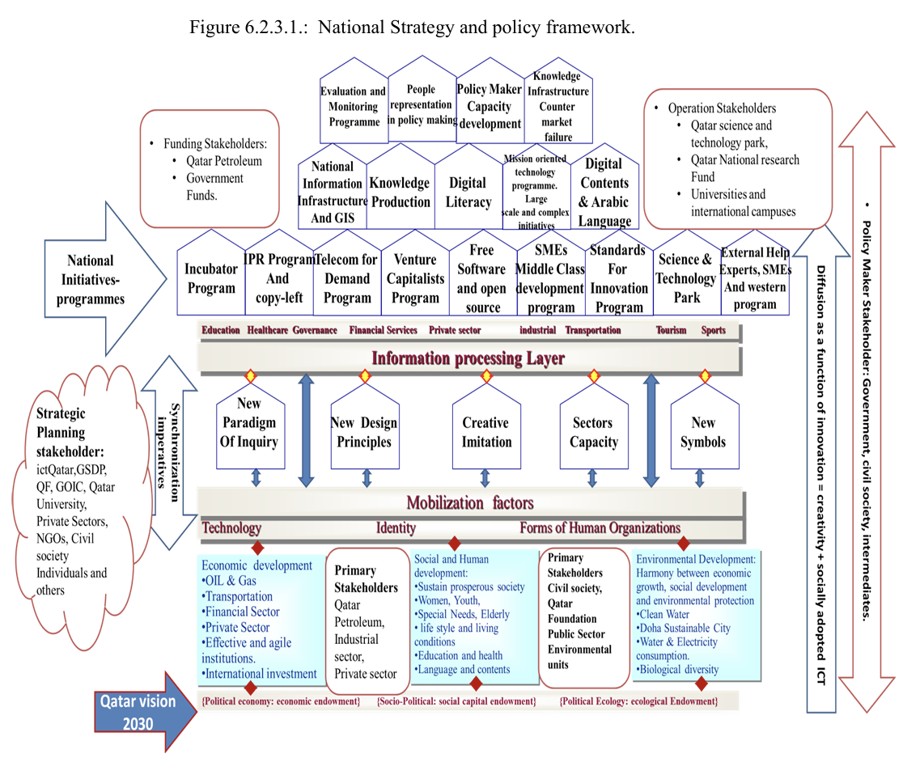
6.2.3. Framework building blocks summary
Figure 6.2.3.; reflects on the above discussion-analysis. The synchronised conceptual model
resides at the centre with links with NationalVision2030 that is based on symmetrical interfaces. From this view, set of national initiatives programmes are enacted. Interdependencies-interconnectedness-interrelationship between these programmes should aim to invigorate the nation production relationship. As a result, new factor endowments (economic, social, and ecological) for Qatar are likely to emerge.
Stakeholder’s model are overlaid and represented through red colour shapes. The prime role for each stakeholder is indicated.
Innovation is presented as a function of creativity plus socially adopted ICT that depends on the whole system.
The building blocks in the figure and their mutual linkages/interactions constitute a system of
distributive networks of innovation (see appendix 9.6 includes summary of the research process as well) at macro and micro national levels.
Figure 6.2.3.1.: National Strategy and policy framework.
7. Conclusions
Addressing seriously the research objectives: “propose Qatar ICT4D and constructive knowledge strategy and policy framework that provide guidance to realise affinity…… vibrant knowledge-society”, reveals many of views. National planning affinity is not a thing; it’s a property and conditions of coordination, arrangement and coherence between knowledge-based society-economy plans and initiatives. To achieve affinity, the conceptual model adopted to guide where in policymaking and strategy intervention decisions in different context can be guided. By maintaining synchronisation enabled by system thinking and sustainable perspective, we can better plan for how unit of analysis in the practice should be reoriented, reconfigured or re-created and enacted to become conducive to Nationalvision2030 development imperatives.
In addition to synchronisation, symmetrical interfaces with QatarVision2030 is crucial in the national planning affinity. Its fundamental basis is the envisioned society which requires creating coherence in the policies that establishes deeper sense of connectedness with the future society development imperatives.
The cascade effect from affinity should aim to bring vibrant knowledge-based-society. Polices should be oriented towards knowledge production, capacity and capability as the factors that are crucial for production, innovation and competiveness. It’s crucial to enact arrangements and mechanisms to produce knowledge and the capacity to use it. CoP’s is only one form that is based on connecting groups. Knowledge-unfolding is paramount because they provide agenda, scope, objective and approaches to where knowledge production and capacity should be enacted. Affluence-life-style assaults on the envisioned-society and QNEDS challenges require appropriate knowledge production and capacity to develop creative solutions. Policymaking should be vigilant in enacting new paradigm of inquiry, new design principles, community capacity for “creative imitation”, new sector’s knowledge, and new symbols to stimulate future thinking. Without producing knowledge by means of new capacity, situated-learning, cognitive-processes, new-knowers, and re-patterning information, the whole exercise might jeopardize the policy and strategic planning. It might produce the ostensible object - i.e. master plan - but not the strategy and the policy framework.
At Macro-Micro level, policymaker’s deeper and rooted responsibility, accountability, participation, capacity, and policymaking linkages with information, knowledge and driving forces must be mandated-instituted-dialogued-debated and become the founding principles of the strategy and policy framework.
Together, the driving forces, information processing and KUKT account for most of the imperatives of the advent-society. While it is difficult to rank each factor in terms of its importance, empirical study explanatory power offers some level of generalization. The centrality of driving forces as an enabler-catalyst-crystallizer must be stressed. At large, driving forces loom as the ultimate political (economy-social-ecology) mobilisation power that maintains strong level of deliberation to direct the other factors. It’s the driving forces overriding principals that forms and structures middle class, market failures, coordination, intermediation, civil society, and affinity priorities and conditions.
8. References
ALRAYA newspaper, (2010a) http://www.raya.com/site/topics/article.asp?cu_no=2&item_no=540626&version=1&template_id=18&parent_id=17, accessed 19/6/2010
APC/CRIS (2003) Involving Civil Society in ICT Policy: The World Summit on the Information Society, Association for Progressive Communications (APC) and the Campaign for Communication Rights in the Information Society (CRIS).
Arnold E and Bell M, (2001), Some new ideas about research for development, in partnerships at the leading edge: A Danish vision for knowledge research and development, Ministry of foreign affairs, Copenhagen, pages 279, 316.
Bell Daniel, (1976), The cultural contradictions of capitalisms, Basicbooks, USA,363 pp.
Capra Fritijof (2003), the hidden connections. Flamingo, UK, 272 pp.
Clements B. (2007), Ethics and environment practices, study module C163, distance learning programme, school of Oriental and African studies SOAS, centre for development, environment and policy. ISBN 978 0 86266 279 0.
Fowler A (2000) The Virtuous Spiral: A Guide to Sustainability for NGOs in International Development, Earthscan, Chapter 1, pages 1–16:
Freire P (1981) Continuum. In Pedagogy of the Oppressed, Chapter 2, pages 57–74
Fuchs Christian, (2008), Internet and Society, social theory in the information age, 1st ed. Routledge, New York, page 99.
General Secretariat for development, 2008, Qatar national vision 2030, http://www.gsdp.gov.qa/portal/page/portal/GSDP_Vision_Root/GSDP_EN/What%20We%20Do/QNV_2030.
GOIC and Stanford research institute-USA, (2008), knowledge-Based Industry, development in the GCC region. Reported by Goic Qatar.
Gregson Jon. (2005), Information and communication technologies for development, Study module C104, Distance learning programme, Imperial College London. ISBN: 0 86266 2095.
Gregson Jon. , Kent Ivan (2009), NGO Management, Study module C132, Distance learning programme, School or oriental and African Studies. ISBN: 978-0-86266-306-3.
Heeks R. (2002a), Information systems and developing countries: failure, Success, and local improvisations, the information society, 18, pp. 101-112.
Heeks R. (2002b), I-development not e-development: special issues on ICTs and development, Journal of International Development, 14, Wiley Interscience, UK, pages 1-12.
Helen Bright, Bryan Spooener, Karen Wilkin, (2005), Sustainable Development: Approaches and Indicators, study module c101, distance learning programme, imperial college London. ISBN 082662982.
Howel R., Kent R., (2007), The research method, study module R106, post graduate distance learning, school of oriental and African studies, R106 version 1.0.0, ISBN 978 0 86266 299 8..
ICTQATAR (2008), ICT Qatar 2008 to 2010 Master Plan. ICT Qatar, Qatar.
International Monetary fund-IMF; http://www.imf.org/external/pubs/ft/weo/2009/02/weodata/weoselgr.aspx. accessed 18/1/2010.
International telecommunication union-ITU, (2003), Birth of Broadband Executive Summary, Adapted from “The nature of the information society: an industrialized world perspective”, in Visions of the Information Society (ITU, 2003). http://www.itu.int/osg/spu/visions/papers/developingpaper.pdf, Box 2, accessed 30th Jan 2010)
Latham R (ed) (2003) Bombs and Bandwidth, The New Press
Laundvall, Hawke Richard, Mansell Robin, Jim Skea, (1995), standards, innovation and competitiveness, the politics and economics of standards in natural and technical environments. Edward Elgar UK. 269 pp.
Madon, S., (2003), Information Systems and the Economics of Innovation, Edward Elgar, UK, 219 pp. Edited by Chrisanthi Avgerou and Renata Lebre La Rovere.
Madon, S., (2009), e-governance for development, a focus on rural India, Palgrave Macmillan, UK, 178 pp.
Mansell R and Wehn U (1998) Knowledge Societies: Information Technology for Sustainable Development, Oxford University Press, pages 189–190
Mansell R (ed) (2002) Inside the Communication Revolution: Evolving Patterns of Social and Technical Interaction, Oxford University Press 309 pp.
Miles I (1996) The information society: competing perspectives on the social and economic implications of information and communications technologies In Information and Communication Technologies: Vision and Realities, ed Dutton W, Oxford University Press, Chapter 2.
Nicol C (ed) (2003) ICT Policy: A Beginner’s Handbook, Association for Progressive Communications, Association for progressive communication, 140 pp.
O’Malley G and O’Donoghue G (2000). NGOs and the Learning Organisation, BOND, www.bond.org.uk/lte/Ingo.htm [Accessed 24 January 2005]. Quoted in Grgson J (2005).
Qatar Foundation http://www.qf.org.qa/output/Page3.asp, accessed 1st Feb.2010.
Rita Van der Vost. (2006), Sustainable development design and innovation, Study module C103, Distance learning programme, imperial college London. ISBN: 0 86266 254 0.
Schech S. (2002), wired for change: the links between ICTs and development discourses, Journal of International Development, 14, Wiley Interscience, UK, pages 25–38.
Sheikh Hamad bin Jabor bin Jassim Al Thani, director general, General Secretariat for Development Planning “http://www.qatarliving.com/node/556335: accessed Jan 2010)
Sheikh Hamad bin Jabor bin Jassim Al Thani, director general, General Secretariat for Development Planning http://www.qatarliving.com/taxonomy/term/11466, accessed 1st Feb. 2010.
Stockbridge Mike (2005). Socioeconomics of sustainable development, study module c102, distance learning programme, imperial college London. ISBN 0 86266 204 4.
Unwin Tim, Bob Day Daniel A. Wagner, Tina James, Robert B. Kozma, Jonathan Miller, (2005), Monitoring and evaluation of ICT in education projects, ICT and educations series, Information for development programme- Infodev, The International Bank for Reconstruction and Development, The World Bank, 1818 H Street, N.W. Washington, D.C. 20433 U.S.A.
Unwin Tim, (2009), ICT4D, information and communication technology for development, Cambridge university press, UK, 386 pp.
Uy Lallana E and Uy M, (2003), The information Age, e-ASEAN Task Force, UNDP–APDIP. page 13.
Von Stamm Bettina, (2005). Managing innovation, design & creativity. Jhon Wiley & sons, England, 429 pp.
Vorst Van D. R., (2006), Sustainable development: design and innovation. Study module c103 version 1.0.0 ISBN 0 86266 254 0, imperial college London.
Webster Frank, (1995), Theories of the information society. Routledge, UK, 257 PP.
Webster Frank, (2006), Theories of the information society. Routledge, UK, 317 PP.
World Commission on Environment and Development-WCED, (1987). http://www.un-documents.net/ocf-02.htm#I accessed Sept 2010.
Work R (2002). Overview of Decentralisation Worldwide: A Stepping Stone to Improved Governance and Human Development, paper for the 2nd International Conference on Decentralisation 25–27 July 2002, UNDP, New York, page 3.
Bibliography
Beck E., Madon S., Sahay S. , (2004), On the Margins of the “Information Society”: A Comparative Study of Mediation, The Information Society, 20: 279–290, 2004, Copyright c_ Taylor & Francis Inc. ISSN: 0197-2243 print / 1087-6537 online http://folk.uio.no/sundeeps/publications/OnTheMarginsOf.pdf DOI: 10.1080/01972240490481009.
Beniger, James R, The control revolution, technological and economic origins of the information society, (1986), Harvard University Press, USA 493 pp.
Castell M (2000), the rise of the network society. The information age: economy, society and culture 2nd ed. Vol. 1. Blackwell Publishing, USA, 594 pp.
Digital Opportunity Initiative (2001), Creating a Development Dynamic, Accenture, Markle Foundation and UNDP, pages 5–6, pages 19–30 and Chapter 3, pages 32
Freeman Chris, (2007), the oxford handbook of information and communication technologies, The ICT Paradigm, Oxford University press, 620 pp).
Dorward AR, Chirwa E, Boughton D, Kelly V (2007) Evaluation of the 2006/7 agricultural input supply programme, Malawi: interim report. Imperial College London.
Gidden T (2001), the future of the nation state, director‘s lecture, 14 November, London school of economics page 1-11.
Gulf organization for industrial consulting-GOIC http://www.goic.org.qa/. Accessed Feb-Sept. 2010.
Khan AW (UNESCO Assistant Director-General for Communication and Information) (2003) Towards knowledge societies, A World of Science.
Knowledge Ventures (http://www.knowledgeventures.com/) accessed 12 Feb. 2010.
Lamont C. Hempel, (1996), environmental Governance, the global challenge. Islands press, Washington, DC., 291 PP.
Lapton-Bowers P (2003), Teamwork in Humanitarian missions. In Cahill K (ed) Basics of international humanitarian missions. International Humanitarian Series, Fordham University press, New York. Pp. 74.
Mintzberg H, Quinn JB (1992), The strategy process: concepts and contexts. Prentice Hall, Englewood Cliffs, NJ, USA.
Mirghani S. Mohammed, Kevin J. O’Sullivan and Vincent Ribiere (2008), a paradigm shift in the Arab region knowledge evolution. Journal of knowledge management, Vol. 12 No. 5 2008, 107-120, Emerald Group Publishing Limited, ISSN 1367-3270.
Overseas Development Institute-ODI's (2009), policy-making as discourse: a review of recent knowledge-to-policy literature. http://www.odi.org.uk/resources/details.asp?id=2431&title=policy-as-discourse. Accessed August 2010.
Paul A. David, (2007), the oxford handbook of information and communication technologies, economic policy analysis and the internet: coming to terms with a telecommunications anomaly, Oxford University press, 620 pp).
Qatar foundation-QF, science and technology park, http://www.qf.org.qa/output/Page3.asp. Accessed August 2010.
Rentier State http://en.wikipedia.org/wiki/Rentier_state. accessed 22 Jan 2010
Sen A, (199), Famines and other crises. In development as Freedom, Oxford university press, Chapter 7, pages 160-188.
Stehr Nico, (1994), Knowledge societies, Sage publications. London, 291 pp).
Swingewood, Alan, (1991), a short history of sociological thought, St. Martin’s press, inc. New York. 348 pp.
UNDP-Arab fund for economic and social development, (2003), Arab human development report 2003, building a knowledge society, USA, 200 pp.
Ulmer J.(2009), The knowledge society: Text and Orality in Qatar, the international Journal of the Book, Volume 6, number 1, 109-113, ISSN 1447-9516, common ground publishing Pty.Ltd. Australia.
9. Appendices
9.1. Introduction, Questions Guide and research sample groups:
Figure 9.1.1; represents the flow between data collection and model building. Field work governs the production of primary data from the semi structured interview and the focus group discussion; the conceptual model will guide for where to ask question about relevant factors.
Figure 9.1.1; data collection and model building.
Questions Guide
The following list was used as guidance to ask questions during the interaction with the interviewees and the focus group.
Prevailing Practices:
Objectives: to understand the context of the prevailing practices; what is prevailing, why some practices are privileged and why others are not? National problem frame can be drawn in accordance with the findings.
• How knowledge society is best described within the state of Qatar context?
• What is the strategic role of ICT in national strategies?
o Economic growth, development, education, innovation, product diversifications, knowledge based industries, etc…
• What is the role of your organization in achieving the knowledge based industries? What is the real driving forces (technology, cultural, forms of human organizations [state needs, civil society, grassroots etc.]):
o Information and communication technology Counsel in Qatar. ictQatar.
o Gulf Organization for Industrial consulting. GOIC
o General secretary for development planning GSDP
o Qatar Science and Technology Park. Wireless Innovation Centre.
o Supreme education counsel-SEC.
o Government Agencies such as Urban planning for development.
o Middle management in various companies: Qatar telecom and private sector.
• How strategies related to national ICT or knowledge based society or economy is defined, formulated and communicated?
• How ICT related initiative defined, designed and deployed and how linked to Qatar vision 2030 or development context?
• How your organizational mission is coordinated with other organizational missions working in the same objective domain i.e. knowledge based society?
• In case of lack of coordination, what is the framework of reference to make decision and resources utilizations or allocations?
• What is the role of external experts from western companies?
• What and how capacity in the form of knowledge creation/production is being enacted?
• What policy framework is needed and which policy needs to be abolished or re formulate?
• How you will be informed about the measurement of success of your mission and program?
• What is the role of the technology in the making of the future vision of the state of Qatar? Is technology determine or have indirect effect?
• How do you think or see the role of ICT in developing and improving Qatar work force productivity level?
• What is the best interrelationship between expatriates and the Qatari work force in the future knowledge based society? Do you see this relation is critical and crucial in the making of the development goals?
• How much do you see Qatar vision 2030 as a founding principle for knowledge base society? How Qatar Vision 2030 can best be used utilized to create affinity between diverse initiatives?
• Where do you prefer the directions and strategies of knowledge society to focus on or be driven with: education, innovation, informatisation, national information infrastructure, or others or combinations of all. Please describe your views….
• What are those factors that are considered unique properties of the Qatar socio-politics?
Knowledge, Information, the Driving Forces and Policy Making
Objective: Concentrate on the key variables of the conceptual model and the linkages between them to develop deeper insights about knowledge production including policy making, capacity building, informatisation and the driving forces mobilisation factors.
• Specific questions that shed lights on the conceptual framework KUKT. KUKT’s domain can be seen as potential intervention for strategy and policy framework:
o Human Inquiry: what are the deliberate policy processes that ensure human inquiry is conducive to development?
What is more important is information for freedom or information for living conditions?
Asking questions: who decide on the source and the type of questions?
What would impact your ability to process or deal with the diverse source of information and how you can use it?
o Solving problems: How creative design principles are applied in selecting and managing and formulating programs, projects and frameworks? How we can turn the initiatives into innovative outcome?
o Holistic practices: which dialogue, social groups, intercourse and knowledge capacity required?
o Socio-economic development: is there a link between national socio-economic goals in Qatar vision 2030: productivity, competitiveness, sector development (education, health, government, economic), international and regional development agenda and the ICT initiative?
o Integration with the future: do we care about the future and accommodate moral conducts, aspirational thinking and imaginations? What metaphors are appropriate for the future knowledge society?
• Information Processing Capacity:
o What are the factors that impact or influence the trust and perception of the information processing layer?
• Driving forces Mobilisation factors:
o What are the impeding, enabling, catalysing or crystallizing factors? Exploring and identifying the mobilisation factors will help in understanding what are those factors that policy makers should consider in order to guide and influence the plans, directions, strategies and policies for the advent-society? Questions were raised on the basis of prevailing practices, knowledge unfolding, information processing. For example:
Why coordination is weak: answers revealed:
• Lack of governance.
• Participation is not possible due to capacity of people and community.
• Feedback is ad hoc causing uninformed next step action.
Why technology is pre-dominating the planning process? Answers revealed:
• Lack of social-based approaches to deal with technology.
• Large scale implementations enable change through trickledown effects.
Commercialization is given highest priority:
• Lack of awareness about development discourses and market problems.
• Ignorance about what is knowledge and how to deal with it.
• National policy makers are not aware of any alternative to property rights that can be adopted?
How policy makers deal with knowledge, information and forces of change?
What are the those national priority in terms of initiatives and the capacity required for transforming Qatar at the following levels: the following has been explained to the interviewee and the focus group so for answers to be oriented with knowledge production and capacity.
• Human inquiry.
• Problem solving.
• Holistic practices
• Socio-economic development
• Integration with the future.
Research Sample Groups:
• ICT Qatar http://www.ict.gov.qa/output/page2.asp. With key leaders such as General Secretary, Strategic planning and development director, Policy director, E government executive director, Education executives, e-inclusions executive etc…
• Supreme education counsel: http://www.english.education.gov.qa/ Education leads mainly in the evaluation institute of the supreme education counsel.
• The General Secretariat for Development Planning (GSDP): http://www.gsdp.gov.qa/portal/page/portal/GSDP_Vision_Root/GSDP_EN . Knowledge economy project manager, general secretary, Socio-economic strategic director.
• Qatar Foundations: http://www.qf.org.qa/output/Page3.asp. Qatar Science and Technology Park and innovation centre. Both organizations are directly engaged in directing the knowledge based society in the state of Qatar.
• Gulf organization for industrial consulting-GOIC (http://www.goic.org.qa/). Will focus on the status of knowledge based industries and the progress made so far. Addressing the key challenges and future plans.
• Interview with CEOs and leaders working with organizations those missions related to knowledge society such as knowledge venture. Knowledge Ventures (http://www.knowledgeventures.com/) is a wholly owned ICT investment subsidiary of Qatar Foundation for Education, Science and Community Development. Its mission is to help build a knowledge-based society in the region through high-impact ICT investments, and a commitment to the development of people as the main assets and drivers of our future.
• Interview with Information technology managers in key organization such as: Qatar national bank, Qatar Telecom, Qatar Petroleum, and other key practitioner in the field of ICT. The aim here is to capture feedback on the impression and the synergy between enterprises initiatives and the overall Macro level knowledge based society initiatives.
• Qatar National Education Data Systems: QNEDS group.
The above sample group constitute most of the key player’s institutions and individuals working or related in different forms to the knowledge based society. Covering the above sample will establish a foundation for a viable base for the research validity and reliability.
Review documents, records, and published materials
• ICT Qatar: National ICT strategy, Policy Framework, and other related records.
• International organizations: World Bank KAM, IMF, ITU.
• Regional organizations: Gulf organization for industrial consulting. http://www.goic.org.qa/. A GCC organization playing leadership role in establishing knowledge based industries in the GCC countries.
9.2. Appendix: Data Analysis:
My research based on qualitative data analysis. The process of analysis is intertwined with data collection. The analysis process started along with data collection.
As soon as data collected, processing started at the same time or immediately. Data such as field notes, semi-structured interviews responses or document analysis re produced towards set of categories, patterns, meanings, standards, and the organizing principle of people behaviour and thinking.
Moving from field work observation and then grouping or categorization process; next is the phase of building up structural and integrated concepts.
I adopted both top down and bottom up approach by validating, matching and cross checking norms, semantics, answers, views, abstracts and expressions stated by the participants. I grouped them and categorize and then analysed the relationship so as to form a sense of deeper harmony with the specific case I’m studying which is; Qatar.
During the in depth interview and focus group discussion, I reviewed multiple articles, project records, Qatari newspapers and other related litterateurs to see if the research question can be enriched by any source of data. My focus was on ensuring that research themes for the research question remained within the scope of the results. Further, assess possible approaches to strengthen the validity and reliability as for example concept such as “technology pre determine” or “affinity” or “driving forces”, “knowledge unfolding”, “information processing”, ‘middle class’ socio-technical” are consistent concepts and contextualized.
The discussion with the interviewees was very interesting. Coming from different background of disciplines, they are mix of expatriates and Qataris, the latter accounting for 60% of the sample population. The expatriates have been working in Qatar for 4-10 years with track records of experience outside Qatar, some in the region and others at the international level.
By virtue of my personal interaction since 12 years with the Qatari cultures, value system, semantics, authoritative terms and proverbs, fault lines of ideological zones, religious imperatives and privileges, my intention was to uncover the context of the subjective meaning of the responses such as social control, skewed world view, political conflicts, people perception to each other particularly those working in organizations in stark contrasting view to the knowledge society, where people may feel secure with some answers rather than the others and so forth. Additionally, with a lens of researcher and conceptual analysis I directed my investigation to uncover the context of a pre dominant view, who is those actors behind it and why it’s being constructed. Some of hegemonic terms or expressions were there at the time of the research because for example that some experts were able to determine its meaning. What count at the end, these prevailing concept are like a moving targets being constructed and being interpreted in accordance with the nostalgia of temporal factors of the here and the now.
I have also attended multiple workshops conducted by ictQatar, Qatar Telecom, and other international organization such as Digital literacy forum in which discussion took place about the transformation to knowledge society in the state of Qatar and the challenges or impediments facing the country. During these events I had informal interactions with many audiences, interested parties and professional groups. My goal was to capture or realize emerging contexts or theme that is holding sway which I may have not detects it throughout the process of study. Additionally to develop in depth insights into some of the themes I have captured and coded.
9.3. Appendix: Results: Coding and Categorisation:
The scale at which the below data is measured against two extremes strong and weak. Strong indicates the excessive reliance.
General outlook: Prevailing Themes P-ICT
Categories Themes Code
Prevailing ICT practices P-ICT&K
• Weak coordination AFICT-COR
• Technology-mission policy assuming pre-determined outcome AFICT-Tech
• Knowledge Management AFK-KM
o Source of knowledge.
o What determine knowledge
• Market approaches AFICTK-Com
Code ictQatar GOIC GSDP Qatar Foundation Focus Group 1-QNEDS Focus Group 2-I-gov.
AFICT-COR Weak Weak Weak Moderate Weak Weak
AFICT-Tech
Strong Strong Moderate Strong Weak Strong
AFK-KM
Extractive
Expert Extractive
Expert Extractive
Expert Extractive
Expert Expert + local Extractive
Expert
AFICTK-Com Strong Strong Strong Strong Strong Strong
Cascade Effect:
National plans related to knowledge society such as ictQatar master plan do not account or factor for knowledge production to build local capacity.
ictQatar Master Plan 2008-2010: All respondents including ictQatar staff have expressed their disappointment from the followed approach which was based on closed circles between groups of experts.
Stakeholders are just words in papers and not operationalized or linked to a comprehensive strategic framework. Everyone defines the stakeholders as they wish without an agreement on the frame of reference.
Partners from international markets are selected in an ad-hoc basis. Factors such as the perceived image and the brand-name of the company determine the decision.
Integrated Government: is strategic program to ictQatar. Its main focus is on online e-services. The measurement of success is quantitative: how many e-services. The interaction with the National-Vision or the wider development perspective is totally absent. Concepts such as knowledge government or development focus goals are not considered. The priority, scope and objectives have been invented by international consultants and then communicated through formal sessions to the team under “knowledge transfer sessions”.
Both QNEDS and E-Government focus groups emphasized: “We should engage and promote social actors, groups and agents to play a critical role in strategy and policymaking.”
QNEDS suffers from failure in internal coordination, and with other sectors and institutions such as ictQatar.
ICT Initiative design: project based confined to best-practices approaches that replicate success from different contexts.
Driving forces outlook:
Categories Themes Code
Driving Forces Issues: DF
Answers revealed about driving forces by focusing on: policy framework
• Technology DF-TM
Answers revealed through: what are the impediments, catalyst, crystallizers and enablement factors for the driving forces i.e. role of the technology?
Five themes were revealed-Grouped.
Code Outlook 1: Standards Outlook 2: security Outlook 3: ICT deployment and NII Outlook 4: Sustainable approaches to development Outlook 5: Property Rights
DF-TM What and how to integrate? Policies for technology and software procurements and deployments. National standards extracted from international or professional bodies.
Condition: Not engaged in international debate, replication of external sources, costly integration and migration processes. Information confidentiality, privacy and data protections.
Condition: Not clear to us what is going on their? National framework for ICT deployment and management. Which to select centralized (mission oriented) or decentralized (gradual local adaptation).
Conditions: one-fit-all paradigm. Large scale is dominating without differentiating between different type of deployments. User requirements processes, application development practices, software design.
Condition: Lac of awareness about social shaping technology. Although service oriented architecture is used, but still followed linear approaches and technical-centric. Conventional approaches to property rights following western corporates.
Condition: open-source, free-software are not in the radar screen
• Forms of Human organization DF-FHOM
Answers revealed through: what are the impediments, catalyst, crystallizers and enablement factors for the driving forces i.e. Forms of human organizations, Qatar work force? Interrelationship between expatriates and the Qatari work force,
Four themes were revealed-Grouped.
Code Outlook 1 Outlook 2 Outlook 3 Outlook 4 Outlook 5 Outlook 6 Outlook 7
DF-FHOM National Governance to develop frame
of reference for decision processes and
Resources streamlining.
Conditions: governance is a word only, at best is words in papers. Absence of processes and decisions are not synchronized. Tedious contracting and negotiation
with vendors.
Conditions: legitimizing commercial approaches, T&C’s are based on short terms. Very high transaction costs. Market Oriented approaches for
knowledge
production Review, feedback and Decisions are
made on ad hoc basis People Representation in decision making
and policymaking.
Condition: very weak. Stakeholders, partners, brokers
are undermined and mostly is a
Preference of power structure.
Conditions: no systematic approaches. Knowledge production and multidiscipline
approaches to development.
Conditions: expert driven and R&D based.
• Affiliation and Identity DF-AFIDM
Answers revealed through: what are the impediments, catalyst, crystallizers and enablement factors for the driving forces i.e. affiliation and identity?
Five themes were revealed-Grouped.
Code Outlook 1 Outlook 2 Outlook 3 Outlook 4 Outlook 5
DF-AFIDM Participation is very selective and
driven by technology mind-set.
Conditions: women capacity imped her participation. Communication and interaction
with local Community
is important for coordination
Condition: community capacity is serious issue. How to define what information
is needed and how to
Communicate with them?
Condition: information patterning is absence. Social group, Socio-technical and
students culture is confined to consumerism
and western approaches to development and
Education.
Condition: lack of skills and inability to define what information and knowledge is needed for the future. Digital litrecay is important to deal with the world of information.
Conditions: current initiatives are not brining great values.
Knowledge unfolding outlook: Themes outlook
Categories Themes Code
Knowledge Unfolding -creation and production : KUKT
Answers revealed through: What and how knowledge creation/production is progressing by asking the questions above?
• Human Inquiry KUKT-HI
• Solving Problems KUKT-SP
• Holistic Practices KUKT-HP
• Socio-Economic development KUKT-SED
• Integration with the future KUKT-IF
Deliberation-Emergent
Code ictQatar
GOIC QF GSDP Focus Group 1-QNEDS Focus Group 2-E-Gove.
KUKT-HI Weak-Weak Weak-Weak Weak-Weak Weak-Weak Weak-Weak Weak-Weak
KUKT-SP Weak-Weak Weak-Weak Weak-Weak Weak-Weak Weak-Weak Weak-Weak
KUKT-HP Weak-Weak Weak-Weak Weak-Weak Weak-Weak Weak-Weak Weak-Weak
KUKT-SED Weak-Weak weak-Weak Weak-Weak Weak-Weak Weak-Weak Weak-Weak
KUKT-IF Weak-Weak Weak-Weak Weak-Weak Weak-Weak Weak-Weak Weak-Weak
Two values at each cell, the first indicate deliberate and emergent management framework, the second indicate knowledge unfolding factors.
Deliberate indicate that a framework of processes such as policies and procedure, codified knowledge, knowledge management solutions, information dissemination processes are available. Emerging indicate dedicated community of practices that create knowledge, project learning lessons, knowledge agents to intermediate knowledge creation. Deliberation and emerging as a concept extrapolated from Mintzberg H and Quinn(1992) quoted in study module C132 Gregson J. and Kent I. (2009).
Summary of QNEDS results:
Information Processing Capacity
Categories Themes Code
Information Processing Capacity: IPC
Answers revealed through: What and how information processing capacity is characterized? What and how it impact knowledge progression i.e. unfolding?
Answers and feed back by the interviewee and the focus group about what influence perception and trust are based?
• Stability: making sure that processing of data, information-output are not going to degrade or interrupt human activities and services.
• Robustness: services do appeal to human mode of action,
• Integration: interconnection between services are augmenting better performance, cutting cost, and agility, and
• Richness: information diversification and customization.
Information processing indicated that although the systems (QNEDS, E-Governments, and Selected Financial Applications) reflect strong to moderate level of integration, stability and robustness, in the contrary, information richness is generally weak. Information that is demand led and synchronise with KUKT to unfold knowledge is extremely weak.
• Information processing Robustness, stability and integration. IPC-RS
• Information diversification and customization. IPC-D-C
The below revealed by asking if there is any plans or action to link information patterning, structure and policies with knowledge areas: human ability to inquire, solving problems, creative imitation, socio-economic capacity, future knowledge.
o IPC-D-C to Human Inquiry IPC-D-C-KUKT-HI
o IPC-D-C to Problem Solving IPC-D-C- KUKT-SP
o IPC-D-C to Holistic Practices IPC-D-C- KUKT-HP
o IPC-D-C to Socio-economic development IPC-D-C-KUKT-SED
o IPC-D-C to Integration with the future IPC-D-C- KUKT-IF
Code Focus Group 1, QNEDS 8 Interviewee
IPC-RS Strong Moderate-Strong
IPC-D-C-KUKT-HI Weak Weak
IPC-D-C- KUKT-SP Weak Weak
IPC-D-C-KUKT-HP Weak Weak
IPC-D-C-KUKT-SED
Weak Weak
IPC-D-C- KUKT-IF Weak Weak
Policy maker’s capacity
Local Capacity of policy makers LCPM Stakeholders and partner model SHPM Technology diffusion and deployment DIFDEP
Code Outlook 1 Outlook 2 Outlook 3 Outlook 4 Outlook 5
LCPM Policy makers are not thinking about Local knowledge production.
It’s not part of their discipline or knowledge background or conscious. How problems get defined and prioritized and how to link
problems to the national vision? Cognitive activities are
focusing on some factors to the detriment of another. Digital literacy for policy makers is important as it enhance
their capacity to engage in the interactions between
information and knowledge. Technology practices
are very weak. Information, knowledge and the wider forces of change and policy
making are not in harmony. Nor there is a model that links them and
creates synergy. Compartmentalization of each factor, agency,
actor, and sectors is weakening the reciprocal feedback. Ineffective Horizontal and vertical coordination across
sectors. Information sharing and knowledge exchange
between sectors is widely poor.
SHPM • Stakeholders are just words in papers and not operationalized or linked to a comprehensive strategic framework. Every one defines the stakeholders as they wish without an agreement on the frame of reference.
• Partners from international markets are selected in an ad-hoc basis. Factors such as the perceived image and the brand-name of the company determine the decision. Sometimes, on personal preferences basis.
DIFDIP Incremental adaptation to the technology is required not only limited to big bang approaches? We should engage and promote social actors, groups and agents to play a critical role in strategy and policy making.
Impediments to build capacity at QNEDS
Human Inquiry impediments KUKT-I-HI
Problems Solving impediments KUKT-I-PS
Holistic practices impediments KUKT-I-HP
Socio-Economic Development impediments KUKT-I-SE
Integration with the future impediments KUKT-I-FK
Code KUKT-I-HI KUKT-I-PS KUKT-I-HP
KUKT-I-SE
KUKT-I-FK
Capacity Impediments Standards for information contents and message formats.
Ability to act on information. Different and diverse approaches for
data collection and analysis linked to different problems definitions Families Interaction with SEC. Community to
participate in the student assessment and processes. Indicators about Qatar needs of skills: what
capacity are needed. Sector consulting process to build capacity. Language and metaphors such as
think, imagine, realise....
National Capacity Priority to transform Qatar
Human Inquiry priority KUKT-P-HI
Problems Solving priority KUKT-P-PS
Holistic practices priority KUKT-P-HP
Socio-Economic Development priority KUKT-P-SE
Integration with the future priority KUKT-P-FK
Code KUKT-P-HI
KUKT-P-PS KUKT-P-HP
KUKT-P-SE KUKT-P-FK
Capacity Priority Citizens participation. Women participation. Affluence lifestyle, consumerism, and luxury micro-conditions. Doha Sustainable city by enhancing community capacity. Government wide multidiscipline approaches.
Institutions that focuses on collective creation and diffusion of knowledge Future Governance and imagined governance.
9.4. Appendix F: Qatar National vision 2030
A report published by Qatar secretariat for development planning (2008), highlighted Qatar National Vision 2030. The defining characteristics of Qatar Future-Opportunities and challenges:
"Qatar’s sound management of its bountiful hydrocarbon resources will continue to secure improvements in standards of living. However, an improved standard of living cannot be the only goal of a society. To remain true to its values, Qatar must balance five major challenges:
• Modernization and preservation of traditions:
o Preservation of cultural traditions is a major challenge that confronts many societies in a rapidly globalizing and increasingly interconnected world The needs of this generation and the needs of future generations: Qatar will meet the needs of this generation without compromising the needs of future generations.
• The Needs of this Generation and the Needs of Coming Generations
o Qatar will meet the needs of this generation without compromising the needs of future generations.
• Managed growth and uncontrolled expansion:
o Qatar wants to make up ground quickly, but there are speed limits
• The size and the quality of the expatriate labor force and the selected path of development:
o Qatar must choose a development path that is compatible with the targeted size and quality of expatriate labor that are determined by Qatar’s leadership and people.
• Economic growth, social development and environmental management:
o Economic development and protection of the environment are two demands neither of which should be sacrificed for the sake of the other.
Guiding Principles of Qatar’s National Vision
The National Vision builds on a society that promotes justice, benevolence and equality. The Vision embodies the principles of the Permanent Constitution which:
• Protects public and personal freedoms;
• Promotes moral and religious values and traditions; and,
• Guarantees security, stability and equal opportunities
The vision also rest on four pillars: human development, social development, environmental development, and economic development.
The report also highlighted the need for participation from all. National stakeholders are invited to engage in devising future development plans, national stakeholders include:
• Qatar Foundation: Qatar Foundation for Education, Science and Community Development is a private, chartered, nonprofit organization, founded in 1995 by His Highness Sheikh Hamad Bin Khalifa Al-Thani, Emir of Qatar. Guided by the principle that a nation's greatest resource is the potential of its people, Qatar Foundation aims to develop that potential through a network of centers devoted to progressive education, research and community welfare.
• Qatar Petroleum: the prime OIL & GAS government owned company.
• Ministries.
• Civil Society. Is not active locally, regionally nor globally.
• Private sectors.
The role of the higher authority in the country (H.H. Shiekh HAMAD BIN KHALIFA AL
THANI) and his wife: Shiekhah Mozah bint Nasser Al-Misnid are vital in this process. The
highest authority will act as the custodian, power sponsor and chairing the ambitious
9.5. Qatar National Education Data Systems-QNEDS
Source: the below write up is from QNEDS team. The below information is disseminated to wider audiences to provide general outlook about QNEDS.
QNDES was founded in 2006 to be an effective tool for the Supreme Education Council’s (SEC) institutes and departments and those who are interested in the educational field and schools to help providing data on school performance and the processes of education and learning in Qatar as well as contributing in the process of decision making in the educational process and its development.
QNDES is one of the basic follow-up means of the educational development initiative “Education for a New Era” as it provides data on the education in Qatar and its different pillars from students, teachers and schools.
QNEDS Technology Reference Architecture Framework
QNDES works as a basic source of data and information being currently dependent on in creating reports on the educational process; for example, Enumeration data and QCEA results (Qatar Comprehensive Educational Assessment) and School Report Card. In addition, the Evaluation Institute aims at expand QNDES framework to become the basic source for all data and reports, to ensure data accuracy and unification of data sources to avoid any discrepancy resulted from different sources.
QNEDS faces multiple problems and challenges; the low rate of information usage remains the biggest challenge. Parents are not connected to the data and their information needs are not articulated in order to align with the their needs.
QNDES Goals
• Allowing usage of QNEDS’ available data by giving many users access to educational data and information, such as: SEC employees, school principals, teachers, parents, students, researchers and others.
• Consolidating the value of the data available through applying statistical techniques to find new and useful information that helps users to understand the data and the relation between them.
• Linking and categorizing data from many and various sources to make use from all of it together through founding a central database instead of getting it from each source alone.
• Encouraging mutual conversation between educators and those interested in the educational process to achieve the goals of the educational development initiative in Qatar; “Education for a New Era”.
• Providing e-service to contribute to raising the quality of the education.
• Contributing to the improvement of education data quality.
Beneficiaries of QNEDS
• Supreme Education Council Employees
• School Principals
• Evaluation and Education institutes employees
• Supreme Education Institute Employees.
• National planning for development.
• E education national plans.
QNEDS achievements (current and past)
1. Preparing the applications and analysis reports.
The preparation is complete for analysis applications and reports that provide major data and information for the school evaluation process and educational process in Qatar.
Those reports and applications provide the evaluation team with a comprehensive view on the status of the educational process on many levels starting from the comprehensive look at the educational process performance in the country passing through analyzing the performance of all the educational systems in the country independently as well as providing different potentials to analyze and compare through the single or different systems during a specific school year or on different years. It also provides the possibility to move during the study process from the educational system performance to studying the performance of a group of schools inside one single system or each school independently.
QNEDS enables users according to their access rights to access the data in depths and study the performance of a certain stage or grade or even a student through different years, which facilitates for school principals and workers evaluating the educational process and viewing the school performance in details as well as studying the areas of excellence and the flaws and working on treating them.
QNEDs reports, which exceed 80 reports provided in different views that make the current total number of developed applications considered more than two hundred, covering major areas in the educational process for the country that includes the enumeration of students, employees, perceptions of all parents, students, teachers and school principals about the education status in their respective schools. QNEDS currently covers also QCEA.
QNEDS is working currently on preparing a group of applications that provide analysis to the infrastructure of schools and also studying the qualifications of teachers in addition to a group of applications that provides data on school failure cases and international tests.
2. Developing the Data processor
The database is formed of raw data where the data processor functionally extract data from different sources like enumeration, different questionnaires, QCEA results and others, then uploading it in the storage where it is “refined” (conforming it according to the specified standards), then collecting stamping it with the time or date in a specific form, then uploading it to databases to be used via data access tools. The data goes through a lot of transformations and is put at the end in data structures different from the other structures which it came from.
These changes are put in evidences that contain databases processing rules. Those evidences are managed by data conversion tools. The data processor development is an ongoing process to adapt to the changes occurring in data sources. This process ensures the arrival of data to the final data structure in a manner consistent with data quality standards followed inside the evaluation institute before enabling it to the QNEDS’ users.
3. Development of Data structures
The Data structure is the final place where the data settles after its journey managed by the data processor from its original source to QNEDS. The development of data structure is a continuous process to adapt the structure to all the changes that occur on the nature of the data or in general to improve QNEDS performance.
The QNEDS team made many improvements and changes on the QNEDS data structure to suit the nature of changes that occurred on the data sources and the requirements of data analysis in accordance with the standards of the Evaluation Institute. For example, QNEDS team developed the data structure to support the comparison of performance across years instead of only comparing previous year to the current year in previous structure
Moreover, QNEDS team developed security abilities and data confidentiality inside the structure to support the privacy of data in accordance to the privacy data policies of the SEC.
4. Transfer of expertise and training to SEC cadres and independent schools
Many specialized experts’ visits were organized in the field of data processing to transfer expertise to the council cadres and QNEDs representatives. The expertise transfer included many workshops in which the council cadres were trained on data analysis, processing and auditing, developing applications of analysis and other technical skills that qualify them for the job. The principals and their delegates were trained on using QNEDS and taking advantage of its potentials.
In an opinion poll, the school principal valued QNEDS role in providing information and accessibility which enabled them to evaluate school performance. Many principals had suggestions to develop and improve the utilization of QNEDS. The trainee numbers from independent schools and the council different departments reached nearly one hundred.
Preparation is currently ongoing to train another number of school principal and their delegates.
5. Preparing mechanisms of Registration and Licensing
for school leaders and teachers office
Under the framework of integration between the institute’s different offices and consolidating of benefiting from the existing basic structure in the evaluation institute, work is currently ongoing with the office for registration and licensing for school leaders and teachers to benefit from QNEDS experience and infrastructure in educational data, to establish the teacher Electronic-portfolio. The e-portfolio will enable the school teacher and leader to prepare the requirements of applying to the professional licensing for teaching and school leading. The requirements generally include the school teacher and leader to do the registration procedures and then preparing the necessary documents which proves the worthiness of the applicant to get the professional license in accordance with the national professional standards (NPS).
6. Awareness
The QNEDS team holds workshops with different categories of users to spread awareness about how to take advantage of the QNEDS and the latest updates. The team also issued an electronic newsletter, starting with three experimental e-Newsletters issues which were circulated inside the evaluation institute only as a preparation of the fourth issue in next October for all the QNEDS users including independent schools. Work is also currently ongoing in forming groups of different categories for users to participate in the feedback of QNEDS development to achieve its desired goals.
7. The service of Registration and Selection of Markers
The evaluation institute provides the e-registration service for teachers through the QNEDS portal to facilitate the procedures for teachers who want to participate in marking the students’ answers in tests administrated by the evaluation institute. Teachers can apply for data request applications to mark the test answers in accordance with the specified time periods.
8. Linking Independent schools with QNEDS
Seventy three independent schools till now are linked to QNEDS and currently we are working on linking the rest of the schools in the coming period so that all schools are linked to the QNEDs at the beginning of the coming school year.
9. Challenges
• Diversity of data source which can lead to discrepancy.
• The rapid technological advances which requires continuous development for
o QNEDS environment.
• The incompletion or the inadequate school infrastructure.
10. Future directions for developing the QNEDS
Development Developing tools of communication and engagement between the groups (e.g. parents community) of different users and QNEDS team
Diversification Diversify view options and analysis methods to suit the user type.
Provision Providing rich content beyond reports to cover more information such as, technical support, documentation sample showcase, news and guidelines.
Developing methods Working with the evaluation institute offices to develop methods for collecting and managing educational data
Developing mechanisms Developing methods to take advantage from the wealth of the available data to support studies and researches in the relation of different influences on the educational process and school performance.
Accompaniment Keeping up with the Emir decree on organizing the Supreme Council for education to study adding the Ministry wealth of available data to the QNEDS.
Enabling Enabling the audience to simply access and inquiry processes to QNEDS
9.6. Conceptual Model Insightful Points
Background
The model components; in particular inquiry, problem solving, holistic practices, socio-economic development, integration with the future has been used/adopted during the answer to tutor marked assignments-TMA for study courses C163 and C132 tutored by Clement B. (2007)
The driving forces have been used / adopted during the answer to tutor marked assignment for study course c104 by Gregson J. (2005).
Both provided me with early intellectual exercise and early conceptualisation to build the model. During my study years I was trying to evolve the model by leveraging on the concepts, ideas, practices and the knowledge I gained from all the courses I have studied.
Introduction:
To encompass all of the causal factors that are involved in ICT and knowledge prevailing practices and their critical consequences, model construction exercise is not straight forward. The biggest mental and practical challenge is coming from the diversification in real life situation which is always associated with some level of complexity that requires the addition of new variable or more. The exit strategy from this dilemma is that for a model to be operational, it has to avoid being prescription to the encountered complexities. Hence; a model that is constructed to be broad and elevate multiple causal factors perspectives as oppose to prescriptions based on single-mechanical cause and effect; is the model I was hoping to construct.
The model operational and heuristic capacity availed greater value during the field work and analysis process. The focus was given to the model as a whole, its components and the interaction between them. Each unit is subject to analysis and form a multidisciplinary agenda element for future researches.
A mode of usage to the model could be in the future by exploring national indicators framework that measures knowledge unfolding, information processing, driving forces and their reciprocal interlocking-interactions. Gaps in capacity and diffusion of ICT benefits can be traced to the indicators. It’s similar to what I have done in this research when I studied the prevailing practices and studied them in light of the conceptual model. The aim was to make links between the practices and a model that cover wider spectrum of interconnected driving forces, informatisation, and knowledge production along with capacity to absorb the knowledge. By composing indicators, national data collection programme can help in gathering diversified data about the conditions of the units of analysis in the model.
Practical experience
Although testing the model in terms of theoretical viability and methodological implementation is not within the scope of this research, the model explanatory power has been tested to a certain extent. The model enabled the understanding for each particular prevailing practice and its critical dimensions (driving forces, informatisation and knowledge unfolding). Further, the model has guided the process of data collection and analysis and proofed to be heuristically potent and operationally empirical.
Constraints
Reaching comprehensive analysis that covers all the availed causal paths and factors by the conceptual model was not possible. The limitation of number of words along with the scope and objectives of this research and the adopted research design strategy, all made it uneasy to extend the analysis. Studies that is based on longitudinal and cross-sectional research design strategies may help in extending the manner in which the model can be enriched and explore new areas, for example by focusing on the development of critical causal factors and its interaction over longer period of time or by cross-sectional comparison between sectors. It thus follow, my next step is to proceed with research agenda that help in exploring the model and testing its viability through different contexts associated with different research design methods.
Synchronisation and symmetrical interfaces with the National Vision 2030
Attaining synchronization and symmetrical interfaces with the national vision programmes ensure a dynamic/adoptive/situated perspectives and processes. That’s it, what is built is amenable, evolve a living system not abstract, a daily life, a grapple with the collective mundane problems of everyday life, an institutions and structural arrangement to codify the policy that command knowledge creation/production and the synchronization needs of the national plan.
Building on the synchronised model, and by ensuring symmetrical interfaces with the national vision endowments programmes such as the vision of the future society, national initiatives can be identified, configure, structured, and enacted accordingly. The upper section of figure 6.2.3.1, represent set of national programmes that emerged from the synchronised model and the symmetrical interfaces with the national vision endowment programmes. The interconnectedness between these programmes is the base for the renovated production relationship for the advent knowledge-based society-economy.
Each programme addresses scope, objective, approach and practices being articulated, defined, promoted, and formulated from strategy and policy framework: Macro policy context, Micro policy, the overlapping between both.
If these programmes were able to generate new factor endowment for Qatar, which means the political economy factor endowment measured in terms of wealth will realize revenue and profit from new factors endowments. Socio-political and political ecology factor endowment should then be measured in terms of new knowledge conjunct with local-experience. It’s possible to forecast the emergence of new paradigm and a lock-in to “renovated trajectories”.
E-readiness, Informatisation and Citizens-government relationship
The driving forces play the role of e-readiness at technology, forms of human organizations and affiliation/identity. The scope span over wide areas including policy framework for the advent society, driving forces mobilisation factors such as: National Information Infrastructure, E-legal framework, accessibility/affordability, market policies, e-business, on-line Government, ICT trends including open source, standards, mobile services etc. Stakeholders, networks and partners should rate, rank and engage in a dialogue for the scoping, objectives and approach.
Information processing based on demand constitutes informatisation for development objectives.
Knowledge unfolding constitutes the relationship between citizens-society-government.
It follows that knowledge-based society can base its strategy and policy on the following pillars:
• E-readiness: driving forces.
• Informatisation: information based on demand.
• Citizens-society and government relationships: knowledge unfolding.
Summary of the whole research process and the outcome
9.7. Appendix: Inventive process
Background and overview
The below section is a copy from the study material C103 sustainable development: design & innovation; unit 6.
The reason I’m attaching it here is to use it for supporting the argument about innovation, information patterning, and gathering information relevant to design.
In the below section from invention to innovation; Step two and three are worth given attention. Step two below (setting the stage) is based on collecting information related to the problem. Step three: act of insight-solution is found, which is the “heart of the innovation”, relies on what is called creativity.
The links between gathering information (Step two) and act of insight are dependent on “ “….re patterning information absorbed during the period of information often after receiving a new piece of information that is perceived relevant”.
Therefore, collecting information and re patterning this information are the crucial factors in the innovation process. Correspondingly, gathering information about design principles (second variable in KUKT) that is related to the problem i.e. related to the prevailing-design-principles, patterning information, connecting through CoP’s or under other forms, and improving capacity of user to absorb the information, all are part of the virtuous cycle of innovation in the knowledge-based society.
Accordingly, diffusion to the benefits from ICT depends on the innovation function which is creativity plus implementation-social adoption of ICT, depends to a large degree on a system that is first) sustaining gather information related to problems-collecting, second) support re patterning the information, third) improve the capacity of user, firm, farm, community and the sector to absorb the information and fourth) provide the right conducive to innovation environment for individual, firm, farm, community, and sector to act upon the new know-how by producing something new i.e. well-embodied design solution.
From invention to innovation.
An invention is ‘a creation (a new device or process) resulting from study and experimentation’ (http://www.thefreedictionary.com/invention). Or: ‘An invention is a novel idea that has been transformed into reality and given physical form such as a description, sketch or model conveying the essential principles of a new product, process or system.’ (OU Block 1, page 5)
Invention forms an essential part of the innovation process, where some inventions are designed to improve the performance of existing products and processes some inventions are designed to replace existing products and processes with completely new technology sometimes a need exists which is not met by a current invention sometimes an invention is developed which does not meet a current need some inventions arise from the technical curiosity of an inventor The inventive process can be described through a four-step model
Perception of the problem; recognition of an unsolved problem or one with an unsatisfactory current solution
Setting the stage; collecting information related to the problem
Act of insight; a solution is found by a mental act that goes beyond the act of skill normally expected of a trained professional in that field
Critical revision; the solution is fully explored and revised, with possible refinements due to new acts of insight.
Step 3 of the four-step model, the heart of innovation, relies on what is generally called creativity. Creativity is ‘the ability to make or otherwise bring into existence something new, whether a new solution to a problem, a new method or device, or a new artistic object or form’ (http://www.uk-idea.co.uk/html/basics.html) ‘This is a period when the problem is no longer being given conscious attention but has been put to one side, on purpose or not. But, despite appearances, the subconscious mind is hard at work. During this time … the relaxed brain is re patterning information absorbed during the period of information often after receiving a new piece of information that is perceived as relevant. Suddenly, a flash of inspiration or insight suggests a solution (or the means of achieving a solution) to the inventor.’ (OU Block 1, page 25)
The act of insight, the creative aspect, is bound up with the inventor’s personal make-up, objectives and motivations, guided by environmental characteristics and hardly responds to economic incentives. The other three steps can all be influenced and even guided by economic incentives.
List of Tables
Table 1.1.1: Qatar GDP Forecast by IMF. 10
Table 2.8.1: knowledge economy index. World Bank. 27
Table 3.2.1.1: ICT Groupings. 32
List of Figures
Figure 1.1.1 Qatar Map. 10
Figure 2.5.1: Three elements model. 21
Figure 2.8.1: The Networked Readiness Index Rankings. 23
Figure 2.8.2: World Bank Basic Scorecard (KAM 2009). 23
Figure 2.8.3: Publications indicator in the state of Qatar. ISI web science. 24
Figure 2.8.4: Patents indicator in the state of Qatar. US patent and trademark office. 24
Figure 2.8.5: Internet hosts indicator in the state of Qatar. ITU. 25
Figure 2.8.6: Indicator about bandwidth per person in the state of Qatar. World-Bank. 25
Figure 2.8.7: Indicator about High-Tech exports in the state of Qatar. World-Bank. 26
Figure 2.8.8: Indicator about rates of scientific and technical articles. World Bank. 26
Figure 3.1.1: Knowledge-unfolding-knowledge-thrust-KUKT Diagram. 29
Figure 3.2.1. Overlapping- variables of driving forces. 33
Figure 3.2.2: Three driving forces. 34
Figure 3.4.1: Conceptual Model interaction. 35
Figure 5.1.1.1: Mind map of the prevailing practices. 41
Figure 5.1.2.1: cascade effect. 42
Figure 5.2.1.1: Knowledge unfolding-Knowledge M. framework and Policymaking. 44
Figure 5.2.1.2: Knowledge unfolding-QNEDS and national planning priority. 45
Figure 5.2.3.1.: Mind map of the driving forces mobilisation factors. 47
Figure 5.2.4.1: QNEDS Driving forces. 48
Figure 5.2.4.2: QNEDS KUKT and information processing. 49
Figure 6.2.1.1: Information needs/demand {kernel/central and nucleus} at various levels. 58
Figure 6.2.3.1.: National Strategy and policy framework. 70
Comments
Loading…