Good and Bad Use Value. (July 2026)
Author
Khalid Faris
When Karl Marx [1] introduced use-value in Capital I [2], he said: “The usefulness of a thing makes it a use-value.” The question that should come to our mind is, does Marx mean by usefulness any product produced by concrete productive activity? The Etymology of usefulness: Derived within English from the root word use + the suffixes -ful and -ness, dating back to the Middle English period (1483), "the fact of being useful or possible to use.”
If we take it that something is possible to use, does it entail that it's going to be useful, which means “that can help you to do or achieve what you want” . But what if I want something that is bad, not good? If I want a nuclear weapon to destroy my enemy?
For Marx, usefulness should be “Use-values are only realized [verwirklicht] in use or in consumption.” Hence, Marx alludes to something realized, not possible to realize (although possible here means contingent on use); these are objects. “A thing satisfies man’s need, whether directly as a means of subsistence, i.e., an object of consumption, or indirectly as a means of production.”
Marx informs that what we realize 1) “The use-values ….constitute the material content of wealth, whatever its social form may be. In the form of society to be considered here they are also the material bearers [Träger] of…exchange-value. “, 2) “Every useful thing, for example, iron, paper, etc., may be looked at from the two points of view of quality and quantity. Every useful thing is a whole composed of many properties; it can therefore be useful in various ways.”
I take it that the first, without the second, is negative, while the second is always positive within the context of “A thing satisfies man’s need”. I am saying this because any commodity is material wealth and a bearer of exchange value, but not every property (the second) is useful for human needs. In other words, Use-value can be looked at from 1) a wealth point of view, 2) the properties and their effect or impact on human society, i.e., “A thing satisfies man’s need…in consumption and means of production.” Can we talk about two dialectically interrelated systems within the capitalist system and how their interplay determines the use-value-governing principles?
The thing that is material wealth but is not a satisfaction of man’s need is our concern. What are these objects or products, if any? In other words, can we talk about the dichotomy that Marx did not anticipate or Das Kapital did not articulate?
How can we address such a dilemma if it really exists?
Use-value is a material reality that constitutes the substance of value, which becomes a historical fact that means it is presupposed in any form of society. The substance of value is its natural form; however, a magnitude of value gives us a value that replaces the natural form with another form serving a different purpose from that of the natural form. If this is the case, then the usefulness of use value is not derived from its natural form but from what transcends it. It follow that we can also deduce if the natural form is set aside or tactically considered, then the use value in reality is contingent not on its natural form but on an artificial form that renders it counter-social, since natural forms are defined or attributed to the natural relation between humans in society within nature or proceed in accordance with nature “When man engage in production, he can only proceed as nature does herself i.e. he can only change the form of the materials. …labour is not the only source of material wealth. …Labour is the father of material wealth, the earth is its mother…. “
We need to elaborate on the natural form of use value to set the dialectics of its natural movement as opposed to a movement that transcends it.
“Man’s need” is a social concept in Marx that extends beyond the mere individual. Under the harm principle of Mill’s [3] the self-regarding is different than the other-regarding, where you cannot use or practice something that steps into the affairs of someone else. If you are “self-regarding” and going to drink alcohol or smoke marijuana or take fentanyl but harm yourself only, this falls short of harming anyone else; you are free. Here we see that the use-value harming yourself but not harming others (let aside the externality problem) is the baseline from which the use-value in a capitalist society is legitimized.
But harming yourself means, for Marx, harming your working capacity, your productive and work relations, so you are harming the working capacity of society. It thus follows that we cannot separate self-regarding from other-regarding when seen in terms of the socio-use-value of working relations among working people.
From here comes a crucial question: if the production of use-value is pledged to the self-regarding, does it mean that use-value is attributed solely to material wealth, while transcending to satisfy human needs at the individual level and in society as a whole? This is the crux of the problem we need to deal with here? Are we living in a transcendent use-value? The question being formulated in context: Does the precedent of material wealth for the self-regarding determine the destiny of use-value? Which implies that transcending the other-regarding use-value in satisfying human needs?
The Use value for every individual is tied to material wealth because it’s assumed that the Use value for other-regarding results from a trickle-down cascade effect. The consequence is that the self-regarding crowd out the other-regarding productive collective capacity and work relations, which means 1) there is no use value directly for the society except for public services and safety, which are borrowed money when the state is under debt conditions, 2) the self is the legal entity as a nation-state citizen, which implies that it’s political and metaphysical.
By political, I mean the legal definition of a person occupying center stage in organizing individual experience at face value (world of phenomena/Kantian world of appearances), that which we cannot ascribe universals to because the nature or the essence of self-regarding properties is not universal, or to say it differently, the purpose or the reason is not explained in universal terms since self-regarding is presupposed. And by metaphysical, I mean that existence is attributed to determinate particulars in a society of self-interested individuals since those individuals come first in being.
It follows that we realize a use value in a capitalist system that is formulated on the basis of the 1) harm principle of self-regarding, 2) trickle-down effect on society, and 3) political & metaphysical citizenship, which has a double-alienation effect: alienating politics from citizens and determining existence by economic self-interest. Can we claim that use value in such a system is bad or evil, i.e., not good?
Use-value, from Marx’s perspective, is other-regarding rather than self-regarding, because essential human beings (universal) should be preserved and uplifted as humans can only give themselves social existence by coming together through the objectification of a world of their creation and reflection. It’s not individuals acting independently and in discrete ways from each other. In Marx’s notion of freedom, social objectification is to be a social power; freedom is the development of the ability and the tri-mutual development of nature, society, and individuals.
The use-value of self-regarding is geared towards material wealth, while that of other-regarding is geared towards social objectification. From here, we think that self-regarding use value is bad and contingent, while other-regarding use value is necessary and good.
Yet, I don’t think I have provided enough to prove my point. What I have done so far is articulate the hinges of the elements of use value. Then the question arises in front of us: how can we prove that self-regarding use value is bad and contingent? We have two possible ways: 1) define use-value as Marx conceives, or 2) As a nation state in the capitalist system and elsewhere in modern history, it plays a central role in the making and destiny of use value, then we need to ask the historical question: Are we getting a republic or a modern monarchy?
I would like to tackle the second because it provides us with concrete historical content, which we can use to draw the political form of today's world system.
I argue that the system of today’s use value generates a monarchical system in oligarchical forms while degrading the republic. The aim of an oligarchy is to control the means of production. Therefore, use value usefulness in consumption or means of production favors the second, that is, not to turn means of production into other-regards value propositions to confine use value in the consumption for the self-regard of individuals. If the use-value is aligned with “A thing satisfies man’s need,” we have a concept of other-regard, but Oligarchy struggles to keep self-regard in play; they will struggle to strip the means of production of labor, in order to keep use-value production used solely for self-regard.
The control mechanism in modern days, which differs from the old, when the perspective was expropriation and colonization,- that workers had been robbed of their own means of production, the history of their expropriation--(CAP875) is violent, is to place freedom through property ownership under the control of financial institutions. In other words, modern property ownership is governed by a democratic system, parallel to a financial system.
The fact that we witness in an indebted nation-state, Marx argued, “The national debt, i.e., the alienation [Veräusserung] of the state – whether that state is despotic, constitutional, or republican – marked the capitalist era with its stamp. The only part of the so-called national wealth that actually enters into the collective possession of a modern nation is the national debt.” P 918. So, who controls the means of production such that use-value satisfies the needs of the means of production? We can read the answer to the system of money borrowing.
“Hence the accumulation of the national debt has no more infallible measure than the successive rise in the stocks of these banks, whose full development dates from the founding of the Bank of England in 1694. The Bank of England began by lending its money to the government at 8 per cent; at the same time it was empowered by Parliament to coin money out of the same capital, by lending it a second time to the public in the form of bank-notes. It was allowed to use these notes for discounting bills, making advances on commodities and buying the precious metals. It was not long before this credit-money, created by the bank itself, became the coin in which the latter made its loans to the state, and paid, on behalf of the state, the interest on the public debt. It was not enough that the bank gave with one hand and took back more with the other; it remained, even while receiving money, the eternal creditor of the nation down to the last farthing advanced. Gradually it became the inevitable receptacle of the metallic hoard of the country, and the centre of gravity of all commercial credit. The writings of the time (Bolingbroke’s, for instance) show what effect was produced on their contemporaries by the sudden emergence of this brood of bankocrats, financiers, rentiers, brokers, stock-jobbers, etc.” P 920.
I conclude here that the use value as material wealth is under the control of national wealth, which is governed by borrowers. Second, national wealth is greater in value than material wealth (an indebted nation-state), rendering material wealth insufficient to satisfy consumption and the means of production. Nation-states then promote politics as a trajectory to overcome this gap by resorting to external resources, either as imperial power or as a cog in their machine. Both imperials and their constituent elements form different gradations of an oligarchical system. The impact on workers is that the self-regard workers are free in the double sense ‘that they neither form part of the means of production themselves, as would be the case with slaves, serfs, etc., nor do they own the means of production, as would be the case with self-employed peasant proprietors.’-(CAP874)’
If society attempts to resolve this gap, two things must take place: 1) politics should go back to society , and 2) society should adopt other-regard use value, which reverses the current pattern of oligarchy, in the hope of restoring the republic or transcending the capitalist system.
It’s the bad use value that we witness today, not the good one.
if we think of good in terms of what is necessary and of bad in terms of what is contingent, we can attribute necessity versus contingent use-value. Is a nuclear weapon or genocide technology (Gaza recent historical example) a necessary use-value? Of course not, because it's contingent on the nation-state power struggle to transcend other states, either to prevent or respond to threats. But in all cases, 1) the definition of threat is contingent on not human needs but on nation-state needs, 2) the response to threat is a use-value of mass destruction contingent on war conditions. Both 1 and 2 were generated because the use-value is linked to the material wealth, solely detaching or, more accurately, distancing it from satisfying human needs.
Use-value for society will have a different structure among those that are made for social needs, which can be identified in terms of others, necessitated by collective activities, without undermining the individual's freedom.
Use value for Marx is the substance of things useful, which render it something necessary because if something is not necessary, it is contingent and transcendent to what is necessary for satisfying human needs. Self-regard, the trickle-down effect, and the political and metaphysical citizenship system operate on the contingency of national wealth, rather than on the necessity of satisfying human needs, thereby supervening what satisfies human necessities. It’s the national wealth trickle-down effect on human needs that characterizes the political forms of today's international system.
By necessity, the organizing principles and the nature of the elements of a use value make it unique, such that it can benefit or be useful in a specific way; that is to say, for common purposes, or what we should ascribe to it, is a universal explanation. Unfortunately, self-regarding individuals render its use contingent by atomizing the benefit to the self, thereby compromising its purpose inherent in its nature and in the way its elements are organized.
Machine learning uses digital properties in a specific way and provides an organizing framework for them. The digital framework's Use-value comes from how these digital elements are organized and their nature. The question revolves around knowledge unfolding. We cannot achieve human satisfaction from knowledge unfolding through self-regarding standards. It’s hard to conceive a digital framework organized in a way that serves individuals without impacting others. Smoking a cigarette in a desert is possible, hence no impact on other individuals, but on the environment; while the usefulness of a digital framework is possible only within a social and environmental context, hence, you cannot do so without regard for others.
If we attempt to limit the digital framework to self-regard, we atomize digital content, dismantling its structure and applying it to individual contingent conditions. However, self-regard is not always negative; the positive aspects are to attribute the self to a universal perspective, and to recognize the purpose and reason by which all selves are united: “Selves of the world, unite!”
The Becoming of the unity of the selves.
Khalid Fares.
References
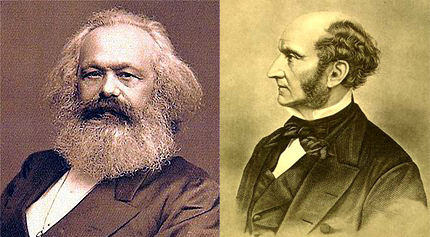
[1] Karl Marx: Karl Marx was a German philosopher, social and political theorist, economist, journalist, and revolutionary socialist.
Born May 5, 1818, Trier, Germany. Died March 14, 1883 (age 64 years), London, United Kingdom
[2]. All of Marx’s quotes from Capital Volume one.
[3]. John Stuart Mill. Philosopher and former Member of Parliament of the United Kingdom. John Stuart Mill was an English philosopher, political economist, and politician. He was a paradigmatic philosopher of liberalism and has been described as "the most influential English-speaking philosopher of the nineteenth century" by the Stanford Encyclopedia of Philosophy.
Comments
Loading…