Capitalism by Occupation, By Colonialism, and By Imperialism (April 2026)
"The Strong Do What They Can—and Suffer What They Must"
Thucydides'.
Author
Khalid Faris
Can we conceive a world without imperials? The slogan that says “everything that is Imperialism, not my business,” is circling out imperialism from social or political change. In other words, the slogan says change without imperialism is not pseudo-politics.
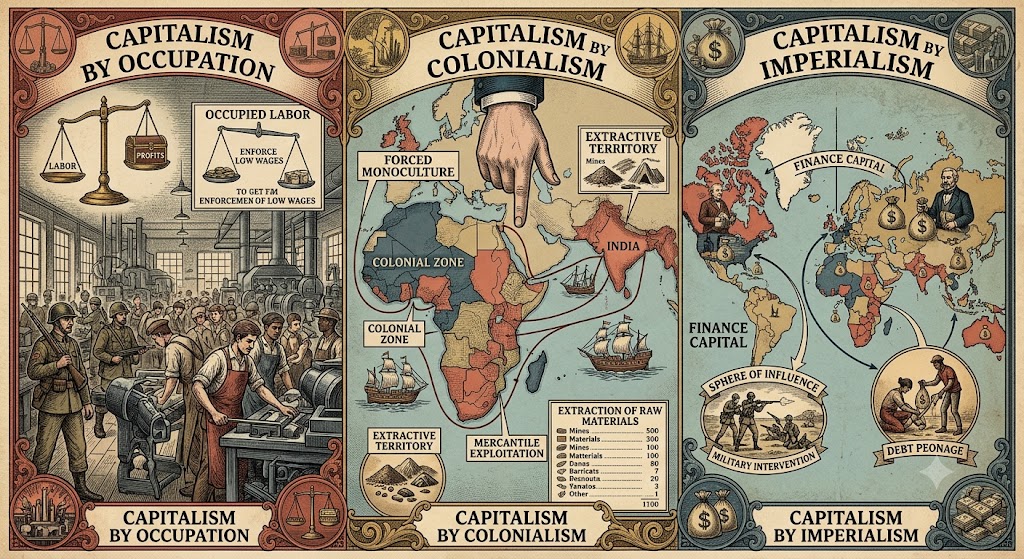
Separating capitalism from imperialism will abstract capitalism to a general system at face value. It thus follows that we have pseudo history when we associate capitalism with its constituent, imperialism, that is, which 1) Capitalism by slavery, national proletariat, and occupation: the expansion of agricultural and industrial capitalist nations from the 16/17th Century to the end of World War I [1]. The period witnessed inter-nation-state wars and civil wars pre- and post-revolutions. 2) Capitalism of nationalists’ imperialism: the alienation and exploitation of people’s self-determination for political freedom and national wealth in other nation-states, where the options for the Arab world, for example, are: 1) a nation-state must be dependent and a cog in a machine of imperial power, 2) No nation-state, such as the Palestinian cause, though this has changed in recent years, yet is incomplete with the American Imperial Veto[2]. In both cases, the self-determination of people falls short of real freedom; the outcome is a system of dictatorship supported and enabled by imperial forces against their people, including unlimited support to the Israeli occupation (inclusive of genocide), with a direct scope aimed at Palestine, and the quasi-direct scope is the whole Arab nations.
When we adopt any political term, we allude to its historical context. If the term suffers from ailing politics, critical theory should look into the wrong practices, not to uproot the term from its historical roots.
History is preserved by the terms with which it is born. Modern times for the critical theorist should represent continuity by lifting the term to its contextual dynamics. Detaching history from its constituent reality, that which imperialism is the center stage, will drive critical theories to the Kantian phenomenal world and pretend that things in themselves are out of reach, so we must remain in the theater of things as they appear to us. According to Kant, we cannot understand what is beyond the phenomenal world.
The difference between true Marxist, and Kantianism that creeped into some of the Marxists in the Frankfort school theorists, is that Marxist deal with constituent elements and structure while Kantians override the constituent because of denial of the world of real things and hence jumps to the world of appearance, confining humanity in general, particularly nations, to a scope of politics aimed at organizing the laws and rights that serve the imperatives of civil society in a nation whilst creating blind spots about politics at the state level and internationally.
In a phenomenal world, we don't have access to the real things (constituent elements of thing-in-itself); therefore, we are obliged to think and practice what is on the surface at face value. Imperialism is not only in the phenomenal world but also in the constituent of the production system: capital accumulation, dollarization, militarization, global wars, and boycotting nations of which its roots lie in “politics is solely for the state without society arrested or overwhelmed in daily economic contingent conditions.”
Existence for Marx is a constituent status of things in themselves, while for Kant, it is strictly regulative in the phenomenal world. For Marx, it is fundamental to unleash these constituent elements from the point of view of being anatomists, i.e., the makers of organisms. On the other hand, for Kant, we can only deal with the organizing power of what we witness in the phenomenal world because it’s a mechanistic dynamic in things as they appear. The way in which we understand the concept for Kant is through heuristic or pragmatic use, with an inability to provide any justification that it refers to something that exists.
When we detach imperialism from capitalism, we detach the latter from the existence of the production system, the making of the global system, and its fundamentals preserved in the constituent elements, all of which Marx clearly dealt with through alienation and exploitation, but also through the superstructure being the transcending force that depoliticized society to confine it to economic business and remain under the politics of a nation-state. This is Imperialism in a nutshell.
The making of a global system by imperial selection is a process we witness live. Such an instance includes when the United States President Donald Trump said that he wishes to “take the oil” in Iran.” [3] What is this, if not imperialism at the core? “A winner takes it all” mentality captures a moment of existence substantiated by Trumpism.
Imperialism today manages to conceal its existence with phenomenal democratic discourse and narrative. But also attempt, seriously and ideologically, to override others’ discourse that negates the existence of discourse that discerns certain nations over others; for instance, “God-chosen people” is a claim of superiority over inferiority when looking at nations and people politically, while rejecting inter-nation epigenetic principles. [4]
Preserving the regional imperial system necessitates a superior-inferior discourse and narrative, an ideology that circumscribes the destiny of other nations within a framework determined or theorized by colonial power elites. The whole idea stems from politics for imperial blocs for superiors, whilst for inferiors, a phenomenal stage should be attributed to them to organize their affairs without reaching the level of politics that grants them free self-determination as constituent elements of their existence.
Mordechai Kedar is a colonialist and religious Zionist, part of a right-wing circle of genocide with Benjamin Netanyahu, who theorizes for a sect/tribe system within the people of Palestine. The combination of colonial politics and religious Zionism has its context in the imperial blocs that founded the state of Israel. The concept of existence for the state of Israel is contingent on the eradication of Palestinian political liberation in a nation-state. The means to that is to attribute Palestinians as people below the political national state. The extrapolation of tribal systems, or any other example, is a contingent anthropological narrative to serve the purpose of a colonial bloc, which cultural religious elites exploit in a nasty and non-human resort to genocide as hard power when soft racist power doesn't work. Edward Said, in his best-selling book, said many things to quote among those: 'This is the consequence of self-inflicted wounds, critics like V.S. Naipaul are wont to say: they (everyone knows that 'they' means colored wogs, niggers) are to blame for what 'they' are, and it's no use droning on about the legacy of imperialism.‘[5]
When Kedar attributes what falls short of an independent nation state to Palestinian, he wants to attribute immanent wounds inflicted of their making, not due to occupation, i.e., his aim is to exonerate Israel. This is a colonial ideology that overrides the real cause for the conditions that Palestinians exist in, which associates inferior attributes with them, tribalizes them, all with an aim of alienation, keeping them inferior with an inability to even strive for an independent nation-state which is for him made exclusively for the sake of discerning superior blocks by ‘the will of God’ so to circle out inferior people to subjugate them under imperial bloc.
Khalid Fares.
1/6/2026.
Note about waves of capitalism
Do we have a third wave of capitalist imperialism? Despite its self-reproductive capabilities, the means of its constituent elements are changing, but not the elements themselves. The constituency of imperialism is relegated to far deeper complex processes in which the scope of the phenomenal world is ever-expanding, dominated by digital and AI technologies as driving forces.
It's not mechanistic as Kant postulated; it's characterized by dynamic digital movement, driven by clicks in a processing power (a quasi-digital world in itself), and then unfolds knowledge into a platform for human experience.
Humans acquire digital experience, so we have a digital-phenomena world for human experience, which many believe requires a regulative system to govern its use pragmatically.
However, the reality is that productive powers, such as electrification, energy sources, semiconductor production, use-value digital labor, and capital accumulation, user-consumption, producer-consumption, are behind the scenes; they are the decisive forces. In turn, it's not the game of regulative but of the existence of the constituent elements. What we see in the history of capitalism is a shift in the phenomenal world, driven by advances in the means of production, their constituent elements, and the conditions of their existence.
[1] Occupation remained in many countries up to the 70’s of the twentieth century. Late Independence: South Yemen: November 30, 1967 (on behalf of Britain). Bahrain: August 15, 1971 (on behalf of Britain). Qatar: September 3, 1971 (on behalf of Britain). United Arab Emirates: December 2, 1971 (on behalf of Britain). Djibouti: June 27, 1977 (on behalf of France). Comoros: July 6, 1975 (on behalf of France).
The United States has used its UN Security Council veto power at least 50 to 55 times since 1970 to block resolutions critical of Israel or directly related to Palestinian. …… The United States has used its veto power in the UN Security Council 93 times since the organization was founded in 1945.
The vast majority of these vetoes—well over half—have been used to block draft resolutions critical of or demanding actions from Israel.
[2] The United States has used its UN Security Council veto power at least 50 to 55 times since 1970 to block resolutions critical of Israel or directly related to Palestinian. …… The United States has used its veto power in the UN Security Council 93 times since the organization was founded in 1945.
The vast majority of these vetoes—well over half—have been used to block draft resolutions critical of or demanding actions from Israel.
[3] https://www.aljazeera.com/economy/2026/3/30/trump-wants-to-take-irans-oil-can-he-and-what-would-that-mean.
[4] Some Israeli politicians, media figures, military officials, and other public voices have used zoomorphic and otherwise subhuman rhetoric to describe Palestinians.[1] This kind of dehumanization ……..[2][3] The Israeli rhetoric classifies Palestinians as non-human species, such as "animals," "vermin," or "insects.
[5] Said Edward (1994). Culture and Imperialism. Vintage. P.20
Comments
Loading…